

CRISPR Explained — From a Bacterial Puzzle to a Child’s Rewritten Gene
Table of Contents
- The Child With One Wrong Letter
- A Short Map of the Words
- The People Who Built the Road
- How the Scissors Actually Work
- The Distinction That Decides Everything
- Casgevy and the Price of a Cure
- Three Popular Lies About CRISPR
- The Question Left Standing
- Sources
The Child With One Wrong Letter
In August 2024, a baby named KJ Muldoon was born in Philadelphia. Within days, doctors found that one gene in his DNA had a single-letter error. That gene, CPS1, tells the liver how to clear ammonia from the blood. When it fails, ammonia rises, the brain is poisoned, and more than half of such infants die in the first week. Survivors often live with severe brain damage.
Six months later, something that had never been done in a living human child was attempted. A team led by Dr. Rebecca Ahrens-Nicklas and Dr. Kiran Musunuru at Children’s Hospital of Philadelphia and Penn Medicine designed a custom gene editor for KJ’s exact mutation, packed it into lipid nanoparticles, and infused it into his bloodstream so that it would reach liver cells. KJ received his first dose in February 2025, between six and seven months of age. His ammonia levels began to stabilize. For the first time, humans had gone inside a living infant and rewritten a letter of his genetic code. The case was published in the New England Journal of Medicine in May 2025.
This is not science fiction. It is a completed medical event, and it raises the only useful question: how did a strange repeating pattern in bacterial DNA become a tool that can rewrite a child’s fate — and what does that tool still refuse to promise?
A Short Map of the Words

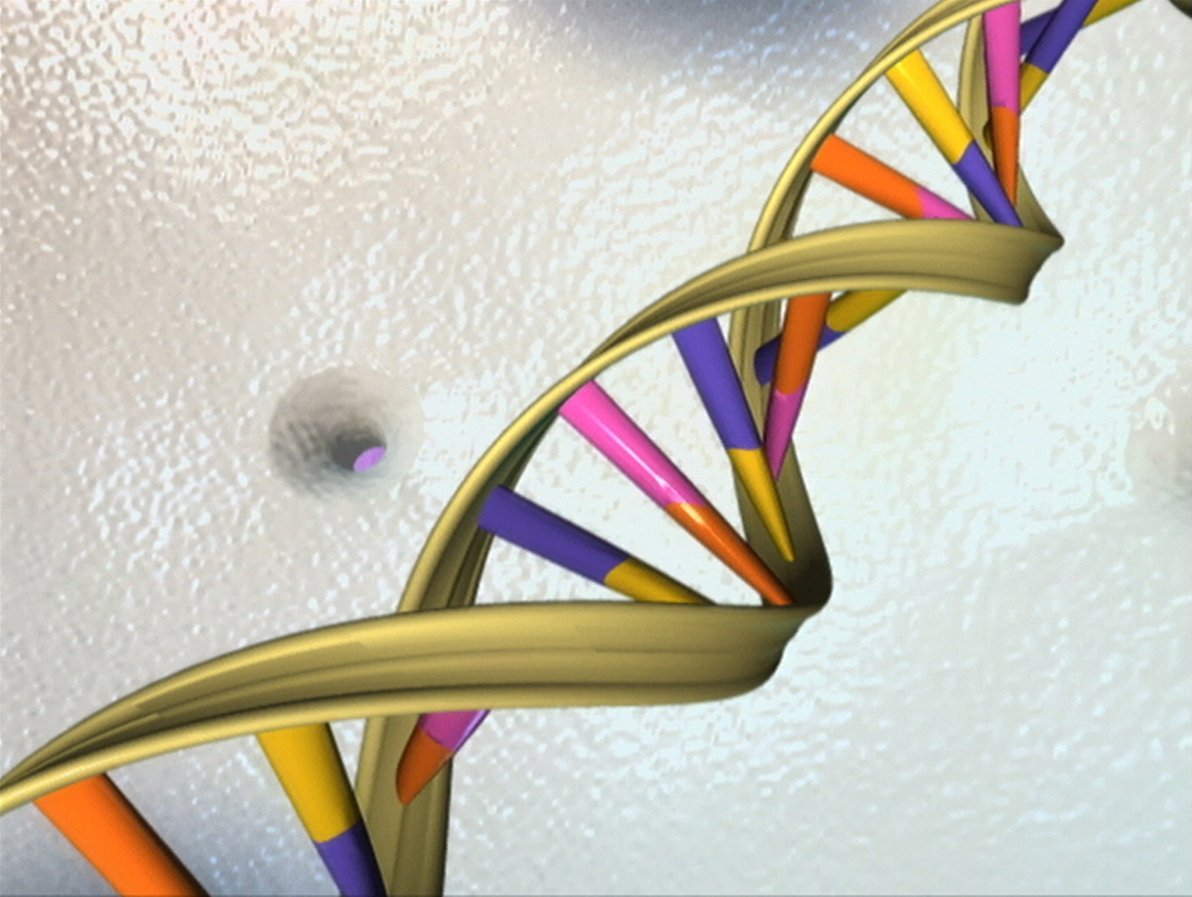
Before the history, three words that media routinely mixes need clearing up:
- DNA — the long chemical text written in four letters: A, T, C, G. It is not a person. It is an instruction set that cells copy and read.
- Gene — a stretch of that text that usually codes for a protein or regulates one. KJ’s problem was one letter inside one gene.
- Genome — the complete library. Humans have about 3 billion letters. Most letters are not “the gene for X.” Most of the library is still poorly understood.
CRISPR does not “change DNA” in the vague sense. A CRISPR system is guided to a chosen address in the library and then cuts, nicks, or chemically converts letters at that address. The difference between a cut and a single-letter rewrite is the difference between a sledgehammer and a proofreader.
The People Who Built the Road
Yoshizumi Ishino, 1987 — the pattern nobody named
In 1987, Japanese researcher Yoshizumi Ishino noticed a strange repeating pattern in the DNA of E. coli. He recorded it and, in effect, wrote that he did not know what it was. Science often begins with an honest shrug. The repeats sat in papers for years as a curiosity.
Francisco Mojica — salt lagoons and a name
Francisco Mojica spent nearly a decade on that puzzle, working in the salt lagoons of Spain. He saw that the repeats were not junk. They looked like an archive of past viral attacks. He gave the system its name: CRISPR — Clustered Regularly Interspaced Short Palindromic Repeats. The name is ugly. The idea is beautiful: bacteria keep mugshots of viruses they have survived, and use those mugshots to recognize the next invasion.
A yogurt factory in France
Rodolphe Barrangou and Philippe Horvath, working at the food company Danisco, supplied the industrial proof in 2007. Dairy companies lose fortunes when viruses attack the bacteria that ferment yogurt and cheese. Their work showed that CRISPR was not a decorative pattern — it was an adaptive immune system. Add the right viral mugshot to the bacterial archive, and the culture resists that virus. Industry funded curiosity because spoiled yogurt is expensive. That is how many tools are born.
Doudna and Charpentier — the programmable scissors
Jennifer Doudna and Emmanuelle Charpentier met in Puerto Rico. Their 2012 paper carried the insight that changed medicine: take the bacterial scissors (Cas9) and give them a synthetic guide RNA that you design. The scissors will then cut whatever address you write on the guide. A bacterial immune system became a programmable tool. They received the 2020 Nobel Prize in Chemistry.
CRISPR did not appear as a “breakthrough product.” It was assembled from a 1987 shrug, a decade of lonely taxonomy, a yogurt factory, and two chemists who asked whether the scissors could be pointed at any gene, not only at a virus.
He Jiankui — the line that was crossed
In 2018, He Jiankui announced that he had used CRISPR on human embryos and that gene-edited twins had been born, in an attempt to disable a receptor used by HIV. The scientific community had drawn a line at heritable (germline) editing of humans. He walked across it. The work was poorly justified, poorly consented, and poorly executed. He was sentenced to three years in prison in China and released in 2022; he has since said he is continuing genetics research, though not on humans. The twins exist. Their long-term health is not a controlled experiment; it is a moral remainder.
He Jiankui belongs in the same story as KJ. The tool is the same family. The ethical difference is not a feeling. It is a technical distinction: whose cells, and whether the change can enter the next generation.
How the Scissors Actually Work

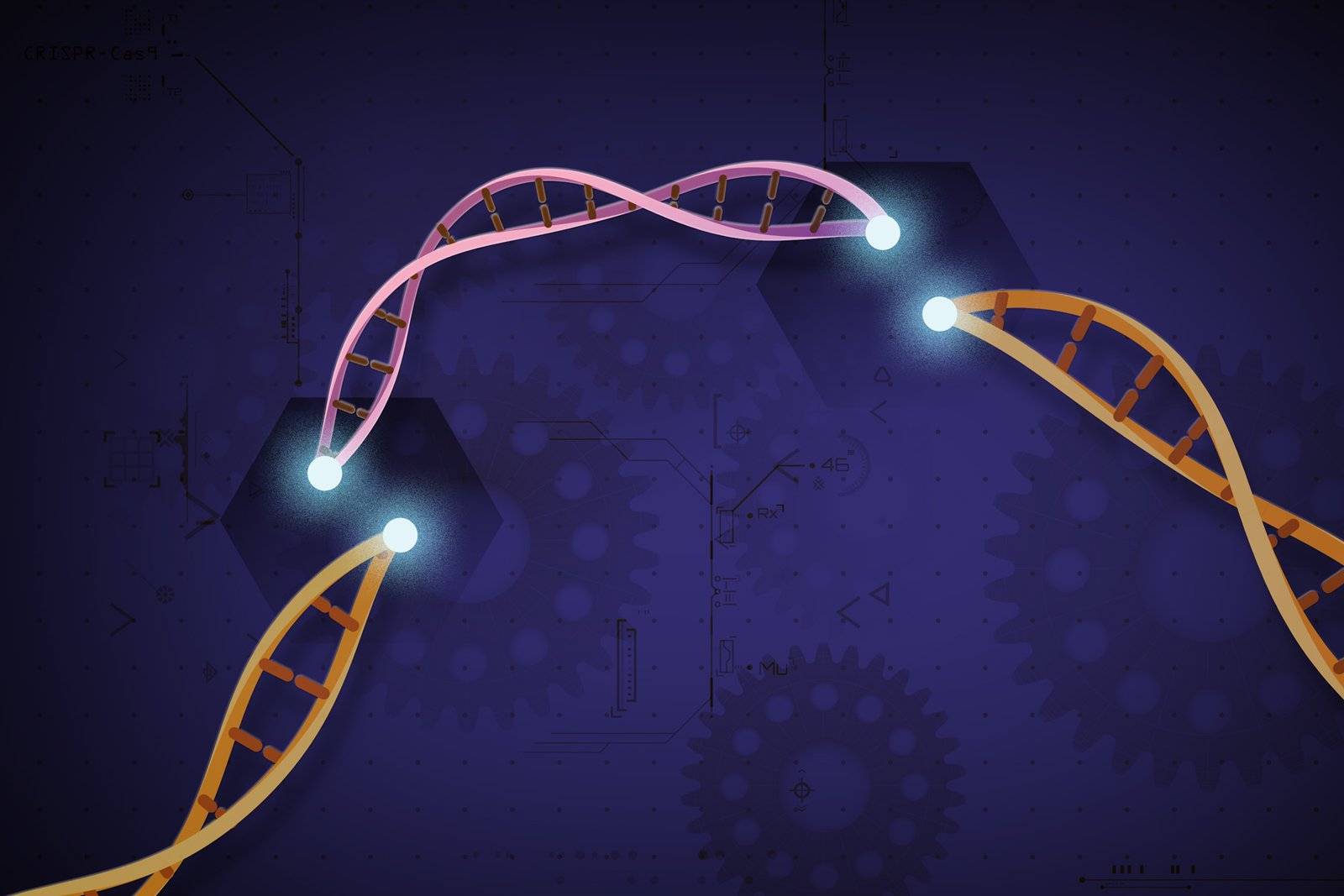
Cas9 is a protein. The guide RNA is a short sequence designed to match the target DNA. Cas9 and the guide search the genome for that match plus a short neighbouring motif called PAM. When both are found, Cas9 cuts both strands of DNA.
The cell then repairs the cut through two main roads:
- NHEJ (non-homologous end joining) — a messy stitch. Letters can be lost or added. Useful if the goal is to disable a gene.
- HDR (homology-directed repair) — if a correct template is supplied, the cell can copy the template into the break. Harder, less efficient, more precise.
KJ was not treated with the original double-strand-cut Cas9 as a blunt instrument. His 2025 personalized therapy used a more precise class of editor — base editing — which chemically converts one letter into another without cutting both strands. That precision is the point of the newer tools: change A to G, or C to T, at one address, with less chromosomal wreckage.
Delivery matters as much as the editor. Viral vectors can carry cargo into cells but persist and can inflame. Lipid nanoparticles — the same family of fat bubbles used in some COVID-19 vaccines — can deliver an mRNA recipe for the editor, act briefly, and fade. KJ’s custom editor was sent toward the liver this way, since that is where CPS1 must work.
The Distinction That Decides Everything
Somatic editing changes cells in a living body that will not become eggs or sperm. KJ’s liver cells, edited after birth, are somatic. If the edit works, it may save him. It does not automatically enter his children.
Germline editing changes sperm, eggs, or early embryos. The change can be inherited by every cell of the child and by that child’s descendants. That is the line He Jiankui crossed. It is also the line most democratic societies have so far refused to license for clinical use, because errors become a family inheritance, and because “enhancement” (height, cognition, appearance) would not stay in the clinic.
The scissors do not know the difference between therapy and design. Only law, medicine, and public argument do.
Casgevy and the Price of a Cure
The first approved CRISPR medicine, exagamglogene autotemcel (Casgevy), treats sickle-cell disease and transfusion-dependent beta-thalassemia. It is not an infusion into a walking patient in the KJ style. It is an ex-vivo process: blood-forming stem cells are taken out, edited so they resume making fetal-type hemoglobin, and returned after the patient’s own marrow is wiped. It was approved by the FDA in December 2023, with a US list price of approximately $2.2 million per patient (roughly ₹18 crore).

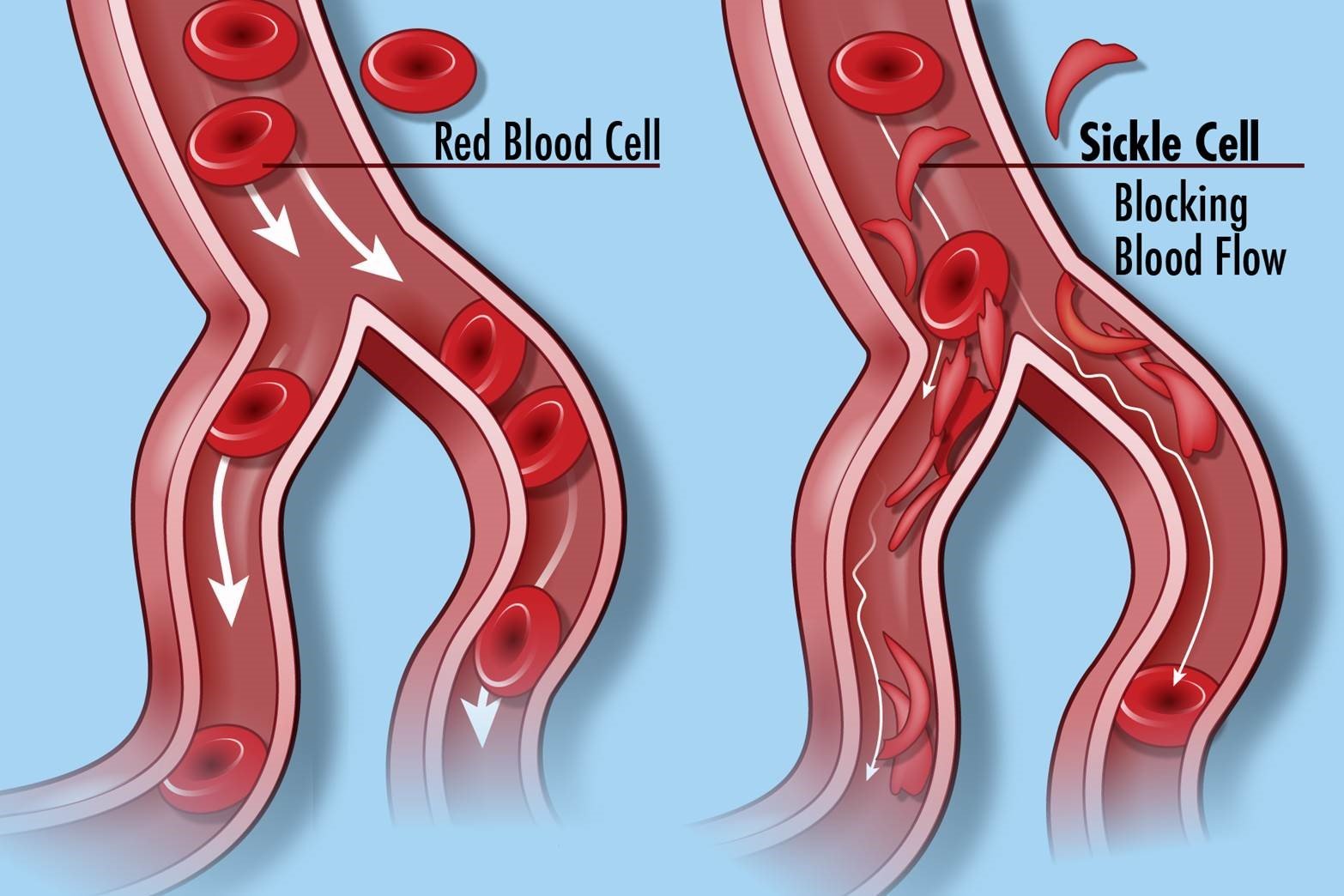
That number is not a glitch. It is the current list-price reality of a one-time, highly specialized, hospital-bound genome edit. Sickle cell is not rare in India — tribal and some regional populations carry the trait at high frequency. A cure that exists only for the global rich is not a completed scientific story. It is an unfinished political one.
KJ’s treatment is even more extreme in one sense: it was custom-built for one child’s unique mutation, under emergency regulatory pathways, in months. That is a scientific triumph and a scalability nightmare. Personalized base editors cannot be stocked on a pharmacy shelf for every rare metabolic disease unless cost, manufacturing, and regulation change by orders of magnitude.
Three Popular Lies About CRISPR
- Lie 1: CRISPR is magic. It is chemistry plus delivery plus repair biology. Off-target cuts, incomplete editing, immune reaction to Cas proteins, and cancer risk from DNA damage remain live research problems.
- Lie 2: If we can edit a baby, we should edit embryos for traits. Trait genetics is polygenic, environment-soaked, and poorly predicted. Embryo editing for IQ or beauty is not an extension of KJ’s case. It is a different project with different victims.
- Lie 3: India can ignore this until the West finishes the ethics. Indian labs already use CRISPR in plants, microbes, and research animals. Indian patients already have sickle cell, thalassemia, and rare metabolic diseases. The question is not whether the tool arrives. It is who owns the patents, who runs the trials, and who can pay.
KJ’s early ammonia stabilization is not a 40-year safety file. Longer follow-up is required, and personalized in-vivo editors will fail in some future children. That is how medicine works. Honesty about failure is part of the same rationalism that celebrates the first success.
The Question Left Standing
If a single wrong letter can now be corrected in a living child, which letters will societies decide are “wrong”? Disease-causing mutations that kill infants are the easy case. Disability that is compatible with a full life is not. Enhancement that flatters parents is not. National projects that talk of “better stock” have a history that no laboratory protocol can wash away.
A Japanese microbiologist who admitted ignorance. A Spanish researcher who named a bacterial archive. French industrial scientists saving yogurt. Two women who turned scissors into a programmable tool and won a Nobel. A Chinese researcher who broke the germline taboo. An American infant whose one-letter error was rewritten before his first birthday. An Indian price tag that turns a cure into a luxury. None of that is mythology. It requires peer review, hospitals, regulators, and a public that can tell somatic therapy from eugenic fantasy.
KJ’s story is a victory of method over fate. The next stories will be victories or crimes depending on whether societies keep the distinction the science itself teaches: edit the disease in the patient who already exists — or redesign the people who do not yet exist.
Humans did not invent the scissors. Bacteria did. We learned to aim them. Aiming is the moral act.
Sources
- Ahrens-Nicklas, R. C. et al. (2025). Custom-designed base editing therapy for CPS1 deficiency. New England Journal of Medicine.
- Children’s Hospital of Philadelphia (2025). World’s First Patient Treated with Personalized CRISPR Gene Editing Therapy at CHOP.
- Wikipedia. KJ Muldoon. (accessed 2026)
- Ishino, Y. et al. (1987). Nucleotide sequence of the iap gene, responsible for alkaline phosphatase isozyme conversion in Escherichia coli. Journal of Bacteriology.
- Barrangou, R., Horvath, P. et al. (2007). CRISPR provides acquired resistance against viruses in prokaryotes. Science.
- Jinek, M., Doudna, J., Charpentier, E. et al. (2012). A programmable dual-RNA-guided DNA endonuclease in adaptive bacterial immunity. Science.
- MIT Technology Review (2022, 2024). Coverage of He Jiankui’s release from prison and subsequent research plans.
- U.S. FDA (2023). Approval of Casgevy (exagamglogene autotemcel) for sickle cell disease.
- NICE / UK NHS (2025). Exagamglogene autotemcel pricing and reimbursement guidance.