
A Comprehensive Archaeological and Anthropological Study of Two of South Asia’s Most Extraordinary Prehistoric Sites
“To study the life of prehistoric man is to hold a conversation across the abyss of time — listening not through words, but through stone, bone, pigment, and seed.”
Table of Contents
- Introduction: Why These Two Sites Matter
- Part One: Bhimbetka — The Cave Shelters of the Ancient Hunters
- Location, Geography and Physical Setting
- Discovery: A Story of Scholarly Rediscovery
- Age: How Old Are the Shelters?
- Who Were the People of Bhimbetka?
- How They Lived: Daily Life at Bhimbetka
- What Did They Eat? Diet and Foraging
- Weapons, Tools and Technology
- The Rock Paintings: A Detailed Taxonomy
- Spiritual Life, Ritual and Symbolism
- Clothing and Body Adornment
- Part Two: Mehrgarh — The World’s First Farmers of South Asia
- Location, Geography and Strategic Position
- Discovery and Excavation
- The Eight Periods of Mehrgarh: A Civilisational Timeline
- Who Were the People of Mehrgarh?
- How Did the People of Mehrgarh Live?
- Weapons and Technology at Mehrgarh
- Social Structure, Governance and Belief
- Trade Networks and External Connections
- The Agricultural Revolution: Significance and Legacy
- Part Three: Comparing the Two Worlds
- Part Four: What These Sites Tell Us About Humanity
- References and Sources
Introduction: Why These Two Sites Matter
To understand the full arc of human civilisation in South Asia — from the earliest nomadic cave-dwellers to the sophisticated cities of the Indus Valley — two archaeological sites stand above all others as foundational chapters: Bhimbetka (also written Bhim Vatika or Bhim Baithka) in Madhya Pradesh, India, and Mehrgarh in Balochistan, Pakistan.
Bhimbetka speaks to us through art — through tens of thousands of years of paintings layered upon sandstone walls, showing us how humans hunted, danced, thought, and perceived the living world around them. Mehrgarh speaks through bones and seeds and mud-brick walls — through the buried record of the world’s earliest farmers in South Asia, the people who first cultivated barley and wheat in the shadow of the Bolan Pass, and who, over millennia, laid the cultural and technological foundations from which the Indus Valley Civilisation would eventually emerge.

Together, they form a continuous narrative spanning perhaps 100,000 years of human experience on the Indian subcontinent. This article examines both sites in exhaustive detail — their age, their physical environment, the people who lived there, what they ate, how they dressed, how they governed themselves, what they believed, what weapons they carried, and how they eventually gave rise to the complex civilisations that followed.
Part One: Bhimbetka — The Cave Shelters of the Ancient Hunters
1.1 Location, Geography, and Physical Setting
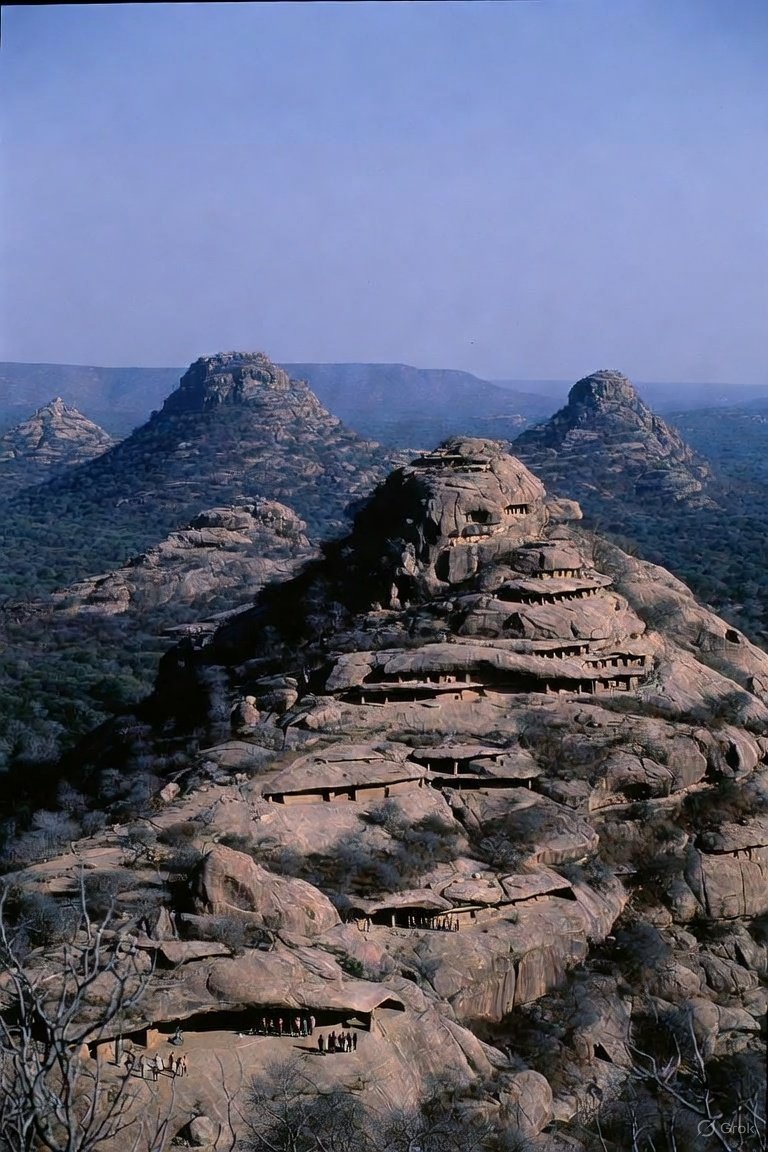
Bhimbetka lies approximately 45 kilometres southeast of Bhopal in the Raisen District of Madhya Pradesh, Central India, situated at the southern edge of the Vindhya Range. The site rests at coordinates roughly 22°56’N, 77°35’E, nestled among the Satpura Hills and surrounded by the Ratapani Wildlife Sanctuary. The name “Bhimbetka” is a corruption of Bhim Baithka — “the sitting place of Bhima” — the mighty Pandava warrior of the Mahabharata, a name bestowed by local Adivasi communities who had long revered the location as sacred.
The rock shelters are carved naturally into massive sandstone and quartzite outcrops that rise dramatically above the Deccan plain, some formations standing nearly 100 metres above the surrounding landscape. The orientation of many shelters — with openings facing east or southeast, allowing morning sun to penetrate the interior — suggests that early occupants understood the thermal and practical advantages of such positioning.
The site is vast. It encompasses seven distinct hills — Vinayaka, Bhimbetka proper, Lakha Juar East, Lakha Juar West, Bhonrawali, Jhondra, and Muni Babaki Pahari — and stretches across approximately 10 kilometres in length and 3 kilometres in width, covering a total protected area of 1,892 hectares.
1.2 Discovery: A Story of Scholarly Rediscovery
The modern world’s attention was first drawn to Bhimbetka in 1888, when a British India official named W. Kincaid mentioned the caves in a scholarly paper, having learned of their existence from local Adivasi communities. However, the site’s true significance lay dormant until 1957, when Dr. Vishnu Shridhar Wakankar (1919–1988), travelling by train through the region, noticed rock formations that reminded him of prehistoric cave sites he had studied in France and Spain — particularly Lascaux and Altamira.
Wakankar led a series of archaeological expeditions beginning in 1957, and the 1970s saw the full scale of the site revealed. By the time systematic research was established, over 750 rock shelters had been identified across the seven hills, with 243 in the Bhimbetka group alone and 178 in the nearby Lakha Juar group. Of these, more than 400 contain paintings.
The site was formally placed under the protection of the Archaeological Survey of India (ASI) in 1990, and in 2003, UNESCO designated it a World Heritage Site, recognising it as “an outstanding testimony to the cultural tradition of the region over a very long span of time.”
Key academic references:
- Wakankar, V.S. and Brooks, R.R.R. (1976). Stone Age Painting in India. Taraporevala, Bombay.
- Mathpal, Yashodhar (1984). Prehistoric Painting of Bhimbetka. Abhinav Publications.
- Bednarik, Robert G. (1993). “Palaeolithic Art in India.” Man and Environment, Vol. XVIII, No. 2, pp. 33–40.
- Singh, Manoj Kumar (2014). “Bhimbetka Rockshelters.” Encyclopedia of Global Archaeology. Springer. pp. 867–870.
1.3 Age: How Old Are the Shelters?
This is perhaps the single most awe-inspiring question about Bhimbetka. The evidence — drawn from excavated stratigraphic layers, tool typology, radiocarbon dating, and art style analysis — points to an occupation history of extraordinary depth.
Archaeological evidence indicates the site was inhabited more than 100,000 years ago. The ASI has formally stated that evidence confirms continuous human settlement from the Stone Age through the late Acheulian and late Mesolithic periods until approximately the 2nd century BCE — a span of occupation across some 100,000 years. The site also contains what are considered the world’s oldest known stone walls and floors.
The rock paintings constitute a stratified artistic record. While many scholars conservatively date the oldest paintings to around 10,000 BCE, Dr. Wakankar argued that the earliest Upper Palaeolithic paintings could be as old as 40,000 BCE.
| Period | Approximate Date | Cultural Phase |
|---|---|---|
| Earliest Habitation | 100,000+ years ago | Pre-Acheulean / Acheulean |
| Lower Palaeolithic | 500,000–100,000 BP | Large handaxes, cleavers |
| Middle Palaeolithic | 100,000–40,000 BP | Scrapers, smaller tools |
| Upper Palaeolithic | 40,000–10,000 BP | Blades, burins, borers |
| Mesolithic | 10,000–4,000 BCE | Microliths, complex art |
| Chalcolithic / Early Historic | 4,000–200 BCE | Pottery, trade, inscriptions |
1.4 Who Were the People of Bhimbetka?
The inhabitants of Bhimbetka across its long occupation history were not a single people but represent successive human populations over deep time. The earliest occupants, associated with Acheulean tool traditions, were almost certainly Homo erectus or archaic Homo sapiens — forms of humanity that had migrated out of Africa into the Indian subcontinent during the Lower and Middle Palaeolithic.
By the Mesolithic period (roughly 10,000–4,000 BCE), the people depicted in the cave paintings and associated burials were anatomically modern Homo sapiens — people essentially indistinguishable in biology from present-day human beings. Physical features evident from comparable South Indian Mesolithic skeletal remains suggest gracile to medium-robust builds, average height around 160–165 cm for males, and physical adaptations consistent with an active, nomadic lifestyle.
These were people of deep intelligence, creativity, and social sophistication — not the crude, shuffling “cavemen” of popular imagination, but cognitively modern humans with language, social organisation, spiritual beliefs, and artistic sensibility.
1.5 How They Lived: Daily Life at Bhimbetka
Shelter and Settlement Pattern
The rock shelters served as primary dwelling spaces. These were not “caves” in the deep, enclosed sense but rather natural overhanging ledges and shallow chambers in the sandstone outcrops — deeply recessed enough to provide protection from rain, sun, and wind, but open enough to allow light and air. Many shelters have relatively flat floors and spacious interiors, making them remarkably comfortable as habitations.
Evidence for the world’s oldest stone walls and floors at Bhimbetka implies that inhabitants modified their shelters over time, constructing rudimentary partitions and levelling surfaces — primitive but functional architecture of habitation.
Social Organisation
The scale of the paintings — depicting large communal hunts, group dancing scenes, and battle scenes — strongly implies that inhabitants lived in bands of approximately 15 to 50 people. This is consistent with what anthropologists know of hunter-gatherer group size globally.
The cave paintings depict clear gender roles in some scenes: men are frequently shown as hunters carrying bows and spears; women appear in gathering activities and dancing scenes. Evidence of division of labour is also implied by the specialised nature of art-making — some individuals may have held specialised roles as artists, possibly with shamanic or ritualistic significance.
Mobility and Seasonal Movement
The Bhimbetka inhabitants were fundamentally semi-nomadic hunter-gatherers. They did not occupy the shelters year-round continuously but likely moved through a seasonal territory, following animal herds and plant food availability. Over thousands of years, successive generations returned to the same sites, creating the layered palimpsest of paintings we see today — with newer images sometimes painted directly over older ones.
1.6 What Did They Eat? Diet and Foraging
The diet of Bhimbetka’s inhabitants can be reconstructed from three independent lines of evidence: fossilised animal bones from excavations, depictions in rock art, and analogy with comparable Mesolithic hunter-gatherer populations globally.
Animal Foods
Excavations at and around Bhimbetka have yielded fossilised bones of the following species:
- Deer (Chital/Spotted Deer and Sambar)
- Bison (Gaur — the large wild ox of peninsular India)
- Wild Boar
- Elephant
- Rhinoceros
- Monkeys
- Peacock and other birds
- Fish and freshwater fauna (implied by proximity to the Betwa and other rivers)
Large game hunting was clearly central to subsistence, providing not only high-calorie meat but also hides for clothing, bones for tools, sinew for binding, and fat for waterproofing and lamp fuel. Wild honey collection is explicitly depicted in the cave paintings — a prized food providing rare concentrated sugars in a diet otherwise without refined carbohydrates.
Plant Foods
The ecologically rich environment of the Vindhyan foothills would have supported abundant wild plant foods:
- Wild tubers and roots (yams, various Dioscorea species)
- Wild fruits (ber/jujube, figs, berries, tamarind)
- Seeds and nuts (various grass seeds, wild legumes)
- Seasonal leafy greens
- Mushrooms
1.7 Weapons, Tools, and Technology
Lower Palaeolithic Tools (Before 100,000 BP)
The oldest tools recovered from Bhimbetka are Acheulean assemblages — the characteristic technology of Homo erectus and archaic humans worldwide:
- Handaxes (bifaces): Large, bifacially flaked tools shaped to an oval or pear shape, 10–25 cm in length, made from quartzite and sandstone. Used for butchering large animals, digging, and woodworking.
- Cleavers: Heavy flaked tools with a broad, straight cutting edge across one end — used for chopping through bone and wood.
- Pebble tools / Choppers: Roughly flaked river cobbles used as general-purpose cutting and pounding tools.
Middle Palaeolithic Tools (100,000–40,000 BP)
- Scrapers (various forms): For processing hides, wood, and plant materials.
- Points: Flaked to a sharp tip for use as weapon tips or cutting tools.
- Levallois-like flaking techniques: More controlled core preparation allowing more predictable flake shapes.
Upper Palaeolithic Tools (40,000–10,000 BP)
- Blades: Long, thin, parallel-sided flakes — more efficient use of raw material, producing a longer cutting edge per unit of stone.
- Borers/Awls: Pointed tools for piercing hides to create clothing.
- Burins: Chisel-like tools for engraving bone, antler, and wood.
- Backed blades: Blades with one edge blunted for hafting into wooden handles.
Mesolithic Tools (10,000–4,000 BCE) — The Microlith Revolution
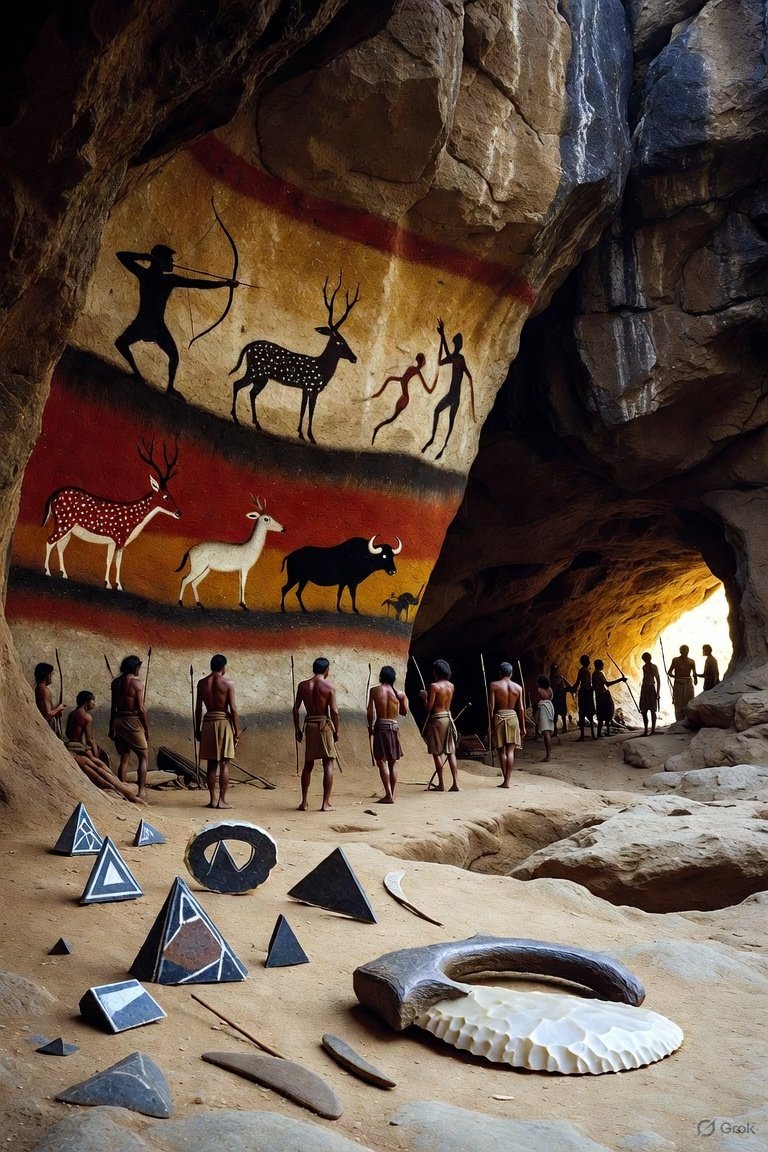
The most dramatic change in the Bhimbetka tool record occurs at the Mesolithic transition. Tools shift almost entirely to microliths — tiny, precisely shaped stone blades and geometric forms (triangles, crescents, trapezia) typically 1–4 cm in length, made from chalcedony rather than the quartzite of earlier periods.
Microliths were composite tools — hafted in rows along wooden or bone shafts to create effective blades, arrows, and spear tips. A single wooden arrow shaft might carry a row of three to five microlith inserts, their sharp edges forming a continuous cutting surface.
Weapons Depicted in Cave Art
The cave paintings of Bhimbetka provide a unique visual record of weapons in use:
- Bow and arrow: Explicitly shown in numerous hunting scenes. Bows appear simple (single-curve), strung with plant fibre or sinew, with arrows tipped by microlith points.
- Spears/lances: Depicted carried or thrown in hunting and combat scenes.
- Pointed sticks: Simple sharpened poles used as thrusting weapons.
- Traps and nets: Implied by paintings showing animals surrounded or enclosed.
The Pigment Technology — Art as Science
The pigment preparation and painting process was itself a sophisticated technological achievement. In total, sixteen distinct colours or shades have been identified in the Bhimbetka paintings:
| Colour | Source Material |
|---|---|
| Red / Ochre | Haematite (iron oxide ore) ground and mixed with fat or water |
| White | Limestone, clay, or possibly bird droppings |
| Green | Green variety of chalcedony or other green mineral rocks |
| Yellow / Orange / Brown | Various grades of ochre (hydrated iron oxides), sometimes heat-treated |
| Black | Charcoal or manganese dioxide (naturally occurring mineral) |
| Purple | Combinations of ochre and charcoal |
Brushes were made from chewed twigs (fibres softened at the end), animal hair, bird feathers, and direct finger application. Colours were always applied in wet form — mixed with oils or water — never as dry powder. This explains why many paintings have survived for tens of thousands of years: the pigment penetrated the stone surface rather than sitting on it.
1.8 The Rock Paintings: A Detailed Taxonomy
V.S. Wakankar classified the Bhimbetka paintings into seven chronological periods spanning three broad cultural eras:
Period I — Upper Palaeolithic (c. 40,000–10,000 BCE)
Large, bold, linear depictions rendered primarily in green and dark red. Subjects include rhinoceroses and bears in massive, simplified forms; human figures dancing and hunting; and simple geometric lines. The scale is large — some animal figures are life-sized.
Period II — Mesolithic (c. 10,000–4,000 BCE)
The most richly populated and artistically expressive phase. Figures become smaller and more detailed. The narrative scope expands dramatically to include:
- Complex multi-figure hunting scenes
- Communal dances depicting both men and women
- Animal herds in dynamic motion
- Battle and conflict scenes
- Honey collection scenes — remarkably detailed, showing figures climbing trees or vine-ladders to reach beehives, with bees swarming around them
- Music scenes — figures with simple percussion and wind instruments
Animals depicted include gaur (bison), chital, sambar, elephant, rhinoceros, wild boar, tiger, peacock, snake, and monkey — rendered with keen observational accuracy.
Period III — Mesolithic Continued
Increasing variety in geometric designs and symbols. Body decoration motifs on human figures intensify, suggesting growing concern with personal adornment and identity marking.
Period IV — Chalcolithic (c. 4,000–2,000 BCE)
Paintings show evidence of contact with agricultural communities. Pottery vessels appear in some scenes. The style becomes more schematic.
Periods V–VII — Early Historic to Medieval
Warriors on horseback appear alongside figures in royal or priestly dress. Geometric and decorative motifs dominate. The temporal depth of Bhimbetka’s art record is parallelled globally only at Lascaux and Chauvet (France), Altamira (Spain), and the rock art of the Kalahari and Australian Kakadu.
1.9 Spiritual Life, Ritual, and Symbolism
While we cannot directly read the minds of Bhimbetka’s prehistoric inhabitants, the evidence for symbolic and ritual life is substantial:
- The persistence of painting across tens of thousands of years on the same surfaces implies specific locations held sacred or ancestral significance.
- Many densely painted shelters show evidence of being uninhabited — separating sacred/ritual space from domestic space, a sophisticated cognitive and social distinction.
- Palm prints and hand stencils — made by placing the hand on the wall and blowing pigment around it — may represent personal identity markers or acts of spiritual contact with the rock surface.
- Mesolithic paintings showing dancing figures with elaborate headdresses may represent shamanic or ritualistic performance.
- The eventual presence of Buddhist stupas, Maurya/Sunga period inscriptions, and Shankha Lipi (shell script) inscriptions within the complex shows the site retained its sacred character well into the historical period.
1.10 Clothing and Body Adornment
The cave paintings provide our best evidence for clothing and personal adornment. From Mesolithic paintings we observe:
- Human figures frequently depicted with patterned or decorated bodies — painted or tattooed skin designs
- Headdresses in dancing and ritual scenes — made of feathers, horns, or plant materials
- Waist garments — simple wrapped cloths or animal skins implied in some figures
- Body ornaments — necklaces, armlets, anklets suggested by linear decorations
Materials for clothing included animal hides (scraped, cured, and sewn with bone needles and sinew thread), bark cloth (beaten inner bark of certain trees), and possibly woven plant fibre textiles in later periods.
Part Two: Mehrgarh — The World’s First Farmers of South Asia
2.1 Location, Geography, and Strategic Position
Mehrgarh occupies one of the most strategically significant locations in South Asian prehistory: the Kacchi Plain of Balochistan, Pakistan, near the mouth of the Bolan Pass — one of the great ancient communication routes connecting the Iranian Plateau and Central Asia to the Indus Valley. The site lies at approximately 29°23’N, 67°37’E, roughly between the modern Pakistani cities of Quetta, Kalat, and Sibbi.
This location was not accidental. The Bolan Pass is a natural gateway facilitating the movement of peoples, animals, ideas, and goods between the great cultural zones of the ancient world. Mehrgarh’s founders chose a site where multiple ecological zones met: the mountains immediately to the north and west provided timber, game, and seasonal pasture; the Kacchi Plain offered flat, fertile alluvial soil; and the Bolan River provided reliable water.
2.2 Discovery and Excavation
Mehrgarh was unknown to the scholarly world until 1974, when a French archaeological mission led by Jean-François Jarrige and Catherine Jarrige, working under the auspices of the French Ministry of Foreign Affairs, began systematic survey and excavation. The Jarrige team worked at Mehrgarh from 1974 to 1986 and later from 1997 to 2000.
Over 25 years of excavation, the project recovered up to 32,000 artefacts, along with thousands of plant and animal remains, structural evidence of buildings, and approximately 360 burials. Jean-François Jarrige himself famously declared:
“The discoveries at Mehrgarh changed the whole concept of the Indus Civilization.”
Key academic references:
- Jarrige, J.-F. (1984). “Chronology of the Earlier Periods of the Greater Indus as Seen from Mehrgarh, Pakistan.” In South Asian Archaeology 1981. Cambridge University Press.
- Costantini, L. (1984). “The beginning of agriculture in the Kachi Plain: the evidence of Mehrgarh.” In South Asian Archaeology 1981. Cambridge University Press. pp. 29–33.
- Moulherat, C. et al. (2002). “First Evidence of Cotton at Neolithic Mehrgarh, Pakistan.” Journal of Archaeological Science, 29(12), pp. 1393–1401. doi:10.1006/jasc.2001.0779
- Coppa, A. et al. (2006). “Early Neolithic tradition of dentistry.” Nature, 440, pp. 755–756.
Note on Dating: A 2025 study published in Nature India by Mutin and colleagues, using new radiocarbon dating methodology, has revised the earliest occupation of Mehrgarh’s Neolithic cemetery to between approximately 5,223 and 4,914 BCE, challenging earlier interpretations that placed the beginning of occupation as early as 8,000 BCE. This remains an active area of scholarly debate.
2.3 The Eight Periods of Mehrgarh: A Civilisational Timeline
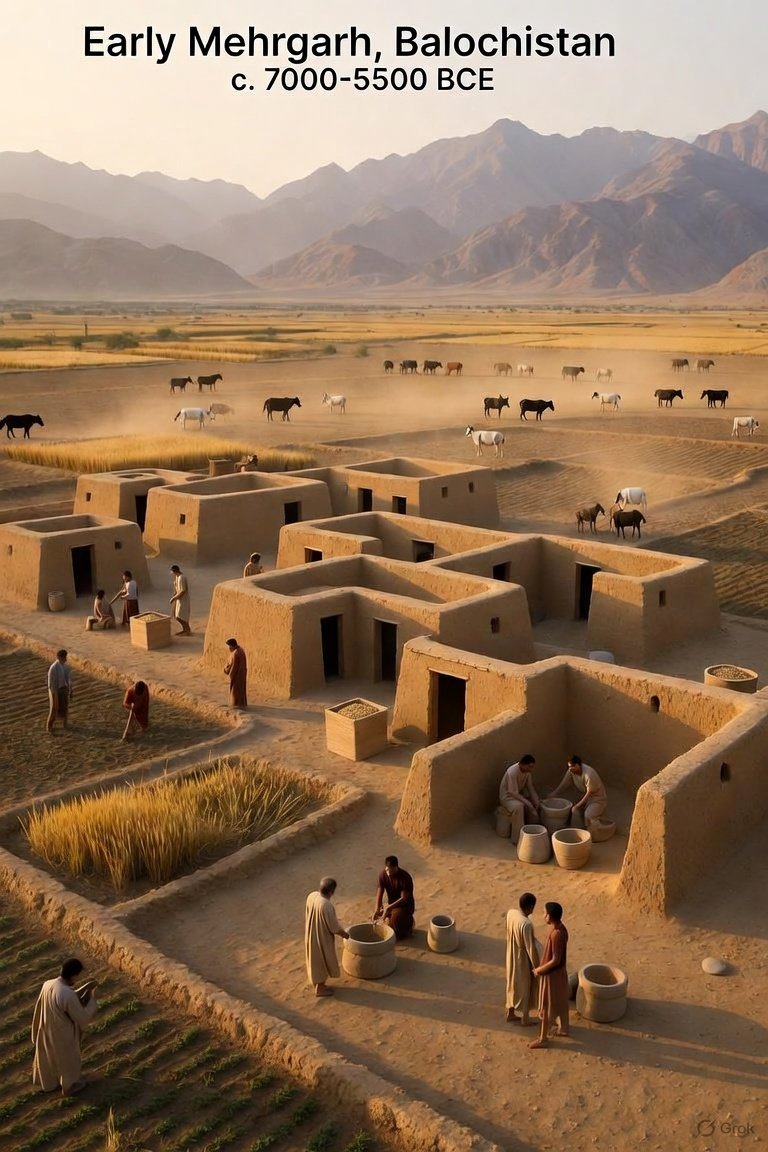
Period I — Aceramic Neolithic (c. 7000–5500 BCE)
This is the foundational period — arguably the most historically important chapter in South Asian prehistory. The name “aceramic” means without pottery: the earliest Mehrgarh inhabitants had not yet developed ceramic technology, relying instead on baskets, gourds, and organic containers.
What Was Built: Simple mud-brick structures with walls of sun-dried clay brick and internal subdivisions of four rooms or more. Some structures appear to have served as granaries — large compartmented storage facilities for grain harvests. The existence of such facilities implies a level of social organisation beyond the individual family: someone had to manage collective storage, decide how much was reserved versus consumed, and protect the stores from pests and weather.
Agriculture — The Revolution Begins: The people of early Mehrgarh cultivated:
- Six-row barley (Hordeum vulgare var. hexastichon) — the dominant crop; fully domesticated form
- Einkorn wheat (Triticum monococcum) — one of the earliest-domesticated wheat varieties
- Emmer wheat (Triticum dicoccum) — another early domesticated wheat
- Jujube (Ziziphus jujuba) — a fruit tree producing small, sweet, date-like fruits
- Dates (Phoenix dactylifera)
Animal Domestication: The animal bones from Period I tell a clear evolutionary story. The earliest layers contain large proportions of wild animal bones — gazelle, wild buffalo, elephant, and swamp deer — alongside the bones of domesticated goats, sheep, and cattle. As Period I progresses, domesticated animal bones increasingly dominate. This trajectory reflects the classic pattern of gradual domestication — not a sudden switch but a centuries-long process of preferential management of certain species.
Burials — A Window into Society: Period I has produced approximately 360 burial sites, many with remarkable grave goods. The dead were typically buried in flexed positions (lying on the side, knees drawn toward the chest), often in pit graves. Analysis reveals:
- Baskets (some coated with bitumen to make them watertight) placed at the feet of the deceased
- Stone and bone tools buried with the dead — practical items for use in the afterlife
- Ornaments — beads of turquoise, lapis lazuli, limestone, and seashell; bangles; pendants; necklaces
- Animal sacrifices accompanying some burials
- More grave goods with male burials in Period I (this pattern reverses in later periods)
The origin of ornament materials is extraordinarily revealing. Lapis lazuli was sourced from Badakhshan in present-day northeastern Afghanistan — hundreds of kilometres away. Sea shells came from the Arabian Sea coast, equally distant. The presence of these materials indicates that long-distance trade networks were already operating in Period I.
Period II — Ceramic Neolithic (c. 5500–4800 BCE)
Period II introduces pottery — a revolutionary technology transforming food storage, cooking, and social practice. The earliest ceramics at Mehrgarh are coarse, hand-built wares with basketry impressions on the exterior — made by pressing clay against baskets used as moulds, showing the transition from basket-technology to ceramic technology.
Other Period II developments:
- Glazed faience beads — among the earliest in South Asia
- Terracotta figurines — more detailed and elaborate; female figurines decorated with paint showing diverse hairstyles and ornamental styles
- Evidence of hide preparation areas with ochre deposits — for tanning animal skins
- Shell ornament manufacture — craft specialisation suggesting dedicated artisans
- Burial patterns shift: Two burials found with red ochre coverings over the body. The amount of burial goods decreases over time, shifting to ornaments — with female burials now showing more goods than male, a complete reversal from Period I
Period III — Early Chalcolithic (c. 4800–3500 BCE)
Period III marks the beginning of the Chalcolithic (Copper-Stone Age) at Mehrgarh:
- Copper use: The earliest copper objects appear — simple pins and small blades representing the first metallurgical production in the region
- Cotton: One of the most startling discoveries — cotton seeds stored alongside wheat and barley, and cotton fibres preserved within a copper bead from a burial. Published in 2002 in the Journal of Archaeological Science by Moulherat et al., these fibres constitute the earliest known cotton in the Old World, pushing back cotton use by more than a millennium beyond previously known evidence
- Terracotta button seals with geometric patterns — proto-precursors to Indus Valley seal technology
- Stone and copper drills for bead production
- Kilns for higher-temperature pottery firing
Periods IV–VIII (c. 3500–2600 BCE)
| Period | Date (approx.) | Key Developments |
|---|---|---|
| IV | 3500–3250 BCE | Pipal leaf and humped bull motifs on ceramics — anticipating Harappan iconography |
| V | 3250–3000 BCE | Intensified craft production; standardised brick sizes begin to appear |
| VI | c. 3000 BCE | Terracotta figurines indistinguishable from mature Indus Valley Civilisation style |
| VII | c. 2800–2600 BCE | Monumental architecture — large brick platform suggesting centralised administration |
| VIII | c. 2600 BCE | Cylinder seals linking to Central Asian cultures; bronze shaft-hole axe; site then abandoned |
Around 2600 BCE, Mehrgarh was abandoned. Its people most likely migrated to the larger, fortified town of Nausharo approximately 5 miles away, as the Indus Valley Civilisation was entering its mature phase.
2.4 Who Were the People of Mehrgarh?
Skeletal remains from Mehrgarh’s approximately 360 excavated burials provide significant anthropological data. Analysis suggests a gracile to medium-built population, physically consistent with other early Neolithic populations of the greater Iranian and South Asian zone. Average stature was modest. Dental wear and skeletal pathology in later periods is consistent with a diet increasingly dependent on ground cereal grains.
The Mehrgarh founders appear to have been semi-nomadic pastoralists from the mountainous regions to the north and west — the highlands of present-day Balochistan and Afghanistan — who descended seasonally into the Kacchi Plain and eventually settled permanently near the Bolan River. Cultural parallels with early Neolithic sites in Iran and Afghanistan (such as Mundigak and Ali Kosh) suggest shared cultural traditions and regular interaction across the greater Iranian Plateau region.
2.5 How Did the People of Mehrgarh Live?
Housing
Period I housing consisted of small, rectangular mud-brick structures — simple by later standards but representing a profound technological and conceptual shift. Mud brick was formed from river clay mixed with chaff as temper to reduce cracking, shaped by hand or in simple moulds, and dried in the sun. Walls were thick enough to provide thermal mass — staying cool inside during the hot day and retaining heat at night. Most structures had four internal rooms, possibly corresponding to functional divisions: sleeping areas, food processing areas, and storage areas.
Food Preparation and Cooking
Without pottery in Period I, food preparation relied on:
- Bitumen-lined baskets for carrying and storing liquids and grain
- Hot-stone cooking: Stones heated in fire and dropped into skin- or bark-lined containers filled with water and food — a technique of great antiquity
- Direct-fire roasting of meat on spits or wrapped in clay
- Saddle querns (flat grinding stones) and hand stones for grinding grain into flour
Once pottery appeared in Period II, culinary possibilities expanded significantly: boiling in ceramic pots allows the full extraction of nutrients from bones and grains, and grain could be made into porridges and flatbreads.
Diet in Detail
Staple plant foods:
- Barley (dominant cereal throughout all periods)
- Wheat (einkorn and emmer)
- Jujube fruit and dates
- Cotton seeds (from Period III — possibly for oil or direct consumption)
Animal foods:
- Domestic goat and sheep (meat, and possibly milk by later periods)
- Domestic cattle (meat, milk, and traction for ploughing in later periods)
- Wild game: gazelle, swamp deer, wild buffalo, elephant — hunted with decreasing reliance as domestication advanced
- Fish from the Bolan River and seasonal water bodies
Clothing and Textiles
For most of Period I, clothing was made primarily from animal hides: scraped clean with stone scrapers, cured, and sewn with bone needles and animal sinew thread. The faunal record of Period I documents large-scale animal butchery, and hide-preparation areas are confirmed by ochre pigment deposits used in the tanning process.
The revolutionary development came in Periods II–III with the emergence of cotton. The cotton fibres discovered at Mehrgarh — confirmed by scanning electron microscopy and published in 2002 — constitute the oldest known use of cotton textiles in the Old World. This predates Egyptian cotton use by more than a millennium and establishes South Asia as an independent origin point for cotton cultivation and textile production.
2.6 Weapons and Technology at Mehrgarh
Stone Tool Technology
Period I at Mehrgarh is characterised primarily by polished stone tools:
- Ground stone axes: Polished stone axes used for woodworking and land clearance. A single ground stone axe was found in a burial — suggesting status association.
- Bone tools: Awls, pins, needles, and points made from animal bone — used for hide-working and craft production.
- Flint and chert blades: Knapped stone tools for cutting, scraping, and butchery.
- Sickle blades: Flint blades with characteristic use-wear (gloss from cutting cereal stalks) hafted in bone or wooden handles — direct evidence of grain harvesting.
- Grinding stones (querns): Flat stone bases and rounded hand stones for processing grain into flour.
- Stone drills: For bead production.
Craft and Metal Technology
- Shell ornament production: Marine bivalves shaped into bangles, pendants, and beads
- Stone bead production: Turquoise, lapis lazuli, limestone, and sandstone precisely shaped and drilled
- Faience production (Period II onward): Glassy, glazed material produced by heating crushed quartz, lime, and copper or other minerals — one of the earliest vitreous materials in South Asia
- Copper objects (Period III onward): Initially simple pin and blade forms, progressing to more complex metalwork
- Bronze (Period VIII): A bronze shaft-hole axe appears, marking the beginning of South Asia’s Bronze Age
The Dental Drilling Discovery — World’s First Dentistry
In 2006, the journal Nature published a landmark paper by Coppa et al. reporting the earliest known evidence of dentistry in a living human at Mehrgarh — the deliberate drilling of tooth enamel. The evidence consists of molars from the Mehrgarh Neolithic graveyard showing perfectly drilled holes with smooth, regular edges characteristic of rotary drilling rather than natural decay.
Experimental reconstruction demonstrated that the drilling was accomplished using flint-tipped bow drills — a wooden shaft with a flint drill bit, spun rapidly by a bowstring. This technology, applied with sufficient skill, can bore through tooth enamel in living patients. The practice appears to have been performed on adults experiencing advanced tooth decay — the Mehrgarh “dentist” was providing a genuine therapeutic service.
This discovery pushes the origins of dentistry back to 7,500–9,000 years ago and establishes Mehrgarh as a site of medical innovation alongside its agricultural and technological achievements.
2.7 Social Structure, Governance, and Belief
Mehrgarh’s social structure evolved significantly across its eight periods:
Early Period I shows relatively egalitarian burial patterns, though the large communal granaries imply some form of collective management — a proto-governance structure.
Later periods show increasing social differentiation: some burials are significantly richer in grave goods than others. The emergence of craft specialists (bead-makers, potters, metalworkers) implies division of labour beyond subsistence level.
Figurines and Spiritual Life:
- Female figurines (the “Mother Goddess” figures): Found from Period I onward, becoming more elaborate through time. Carefully crafted female figures, often shown cradling infants, are widely interpreted as representations of a fertility deity or ancestral figure — a religious tradition that echoes through South Asian spirituality for millennia.
- Animal figurines (especially cattle): The humped bull/zebu becomes a recurring motif — an animal of enormous economic importance elevated to sacred or symbolic status.
- Cenotaphs: Empty graves with grave goods but no body — found at Mehrgarh — suggest individuals died away from home (perhaps on trade expeditions) but were honoured with ritual burial in the community.
Monumental Architecture: By Period VII, a large brick platform appears — suggesting institutionalised authority capable of commanding communal labour in construction projects, a hallmark of proto-state social organisation.
2.8 Trade Networks and External Connections
From the very earliest period, Mehrgarh was integrated into far-reaching exchange networks:
- Lapis lazuli from Badakhshan, Afghanistan (~500–600 km to the northwest): Present in early Mehrgarh burials, demonstrating that trade routes through the Bolan Pass were already active in the 7th–6th millennium BCE.
- Sea shells from the Arabian Sea coast (~300–400 km to the south): Shell bangles and beads appear from Period I onward.
- Turquoise: Sourced from deposits in present-day Iran or Central Asia.
Remarkable parallels between early Mehrgarh pottery, figurine traditions, and architectural styles and those of early Neolithic sites in Iran and Afghanistan (Mundigak, Ali Kosh) suggest shared cultural traditions and regular interaction across the greater Iranian Plateau region.
2.9 The Agricultural Revolution at Mehrgarh: Significance and Legacy
The importance of Mehrgarh for understanding the origins of agriculture in South Asia cannot be overstated. Before its discovery, the general consensus was that South Asian agriculture was derived entirely from the Fertile Crescent. Mehrgarh challenged this view profoundly.
The evidence from Mehrgarh demonstrates:
- Very early, possibly independent agricultural development in South Asia, with domestication of crops and animals proceeding through a locally observable sequence.
- Barley as the dominant crop — consistent with Iranian Plateau agricultural traditions and local wild barley availability.
- Independent domestication of zebu cattle (Bos indicus): While sheep and goats were domesticated in the Near East, the humped zebu appears to have been independently domesticated in the Indus region — with Mehrgarh possibly representing one of the key early sites of this process.
- The continuous development from Mehrgarh to Harappa is the established scholarly consensus. Mehrgarh’s cultural sequence flows without significant discontinuity into the Early Harappan phase, and then into the Mature Indus Valley Civilisation (c. 2600–1900 BCE) — the sophisticated urban culture of Mohenjo-daro and Harappa.
Part Three: Comparing the Two Worlds
The contrast between Bhimbetka and Mehrgarh is, in many ways, the contrast between the Old Stone Age and the New — between the final flowering of the great hunter-gatherer tradition and the first fumbling steps toward the agricultural revolution that would transform human life permanently.
At Bhimbetka, we see humanity at its most adaptive and observant: people intimately embedded in the natural world, tracking animal behaviour with extraordinary precision, navigating complex social dynamics in small bands, expressing profound aesthetic and spiritual awareness in the pigment-rich paintings on their sandstone walls. They were not primitive — they were cognitively modern humans living lives of deep intelligence, physical skill, and spiritual richness.
At Mehrgarh, we see humanity on the threshold of civilisation: people making the wager of agriculture — trading the freedom and variety of the forager’s life for the security and eventual surplus of the farmer’s. They built the first permanent houses in South Asia, stored the first grain in the first granaries, cured the first dental cavities, spun the first cotton threads, and traded the first lapis lazuli across hundreds of kilometres of mountain and plain.
| Feature | Bhimbetka | Mehrgarh |
|---|---|---|
| Location | Madhya Pradesh, India | Balochistan, Pakistan |
| Period of Occupation | 100,000 BCE – 2nd century BCE | 7000 BCE – 2600 BCE |
| Economy | Hunter-Gatherer | Farming, Herding, Trade |
| Shelter | Natural rock shelters | Mud-brick houses |
| Primary Evidence | Rock art, stone tools | Buildings, burials, artefacts |
| Key Achievement | Oldest rock art in India | Oldest farming in South Asia |
| UNESCO Status | World Heritage Site (2003) | Tentative Heritage List |
| Discovered by | V.S. Wakankar, 1957 | Jean-François Jarrige, 1974 |
Between these two worlds lies the entire story of South Asian prehistory — and much of the story of what we are as a species.
Part Four: What These Sites Tell Us About Humanity
Both Bhimbetka and Mehrgarh, separated by geography and thousands of years of cultural development, tell us the same fundamental things about human beings:
We are fundamentally social animals. Every aspect of both sites — the communal hunts of Bhimbetka, the shared granaries and burial grounds of Mehrgarh — speaks to deep-seated cooperation as the foundation of human survival and flourishing.
We are incurably creative. The Bhimbetka painters did not need to paint those walls — survival did not require it. They did it because human consciousness generates symbolic thought, and symbolic thought seeks expression. The Mehrgarh figurine-makers, bead-crafters, and pottery decorators show the same irrepressible aesthetic impulse.
We have always sought the sacred. Both sites show evidence of ritual, ceremony, and belief in dimensions beyond the immediately visible. The Bhimbetka caves served as cathedrals of stone; the Mehrgarh burial grounds were sites of ongoing connection between the living and the dead.
We are restless traders and travellers. Even in the deepest Neolithic, people were moving across hundreds of kilometres, exchanging materials and ideas, building networks that crossed cultural and ecological boundaries.
We are innovators. From the first Acheulean handaxe to the first copper pin, from the first ochre pigment to the first cotton thread, the archaeological record of both sites is a record of relentless problem-solving and invention.
Standing before the painted walls of Bhimbetka, or reading the reports of the 32,000 artefacts recovered from Mehrgarh’s sun-baked mounds, one cannot help but feel the weight of time — and the lightness of it. The people who hunted bison in the Vindhyan foothills 30,000 years ago; who prepared red ochre and reached up to leave a palm print on the sandstone wall; the people who carefully buried their dead at Mehrgarh with turquoise beads and baskets of grain, who drilled their neighbours’ decaying teeth with bow-driven flint bits, who kept cotton seeds in their granaries beside the barley and wheat — these were not distant abstractions, not evolutionary stepping-stones on a journey toward the “real” human beings we consider ourselves to be.
They were fully human. They loved and grieved and laughed and feared. They looked at the night sky and wondered. They taught their children and buried their parents. They made things of beauty when survival did not require it, because beauty is what human consciousness naturally produces when given time and intention.
What they left behind — in stone and pigment, in bone and seed, in the silent eloquence of a 9,000-year-old palm print on a sandstone wall — is not just data for archaeologists. It is the deepest chapter of our shared autobiography.
References and Sources
Primary Academic Sources
- Wakankar, V.S. and Brooks, R.R.R. (1976). Stone Age Painting in India. Taraporevala Sons, Bombay.
- Mathpal, Yashodhar (1984). Prehistoric Painting of Bhimbetka. Abhinav Publications, New Delhi. 225 pp.
- Bednarik, Robert G. (1993). “Palaeolithic Art in India.” Man and Environment, Vol. XVIII, No. 2, pp. 33–40.
- Bednarik, Robert G. (1996). “The cupules on Chief’s Rock, Auditorium Cave, Bhimbetka.” The Artifact: Journal of the Archaeological and Anthropological Society of Victoria, Vol. 19, pp. 63–71.
- Singh, Manoj Kumar (2014). “Bhimbetka Rockshelters.” In Encyclopedia of Global Archaeology. Springer New York. pp. 867–870.
- Agrawal, D.P. and Kharakwal, J.S. South Asian Prehistory: A Multidisciplinary Study. Aryan Books International. p. 149.
- Jarrige, J.-F. (1984). “Chronology of the Earlier Periods of the Greater Indus as Seen from Mehrgarh, Pakistan.” In Allchin, B. (ed.), South Asian Archaeology 1981. Cambridge University Press.
- Jarrige, J.-F. and Lechevalier, M. (1980). “Excavations at Mehrgarh, Balochistan: Their Significance in the Prehistorical Context of the Indo-Pakistani Borderlands.” In South Asian Archaeology 1977. Naples.
- Costantini, L. (1984). “The beginning of agriculture in the Kachi Plain: the evidence of Mehrgarh.” In South Asian Archaeology 1981. Cambridge University Press. pp. 29–33.
- Moulherat, C., Tengberg, M., Haquet, J.-F. and Mille, B. (2002). “First Evidence of Cotton at Neolithic Mehrgarh, Pakistan: Analysis of Mineralized Fibres from a Copper Bead.” Journal of Archaeological Science, 29(12), pp. 1393–1401. doi:10.1006/jasc.2001.0779
- Coppa, A. et al. (2006). “Early Neolithic tradition of dentistry: Flint tips were surprisingly effective for drilling tooth enamel in a prehistoric population.” Nature, 440, pp. 755–756.
- Javid, Ali and Javeed, Tabassum (2008). World Heritage Monuments and Related Edifices in India. Algora Publishing.
Institutional Sources
- Archaeological Survey of India (ASI) — Official page on Bhimbetka Rock Shelters World Heritage Site. [asi.nic.in]
- UNESCO World Heritage Centre — “Rock Shelters of Bhimbetka.” [whc.unesco.org/en/list/925]
- UNESCO Tentative Heritage List — Mehrgarh submission by Department of Archaeology and Museums, Pakistan, 2004.
- Encyclopaedia Britannica — “Bhimbetka rock shelters” and “Mehrgarh” entries.
- New World Encyclopedia — “Mehrgarh” entry.
Recent Research
- Mutin, B. et al. (2025). “New radiocarbon dating at Mehrgarh.” Nature India. [Revises earliest Neolithic cemetery occupation to c. 5,223–4,914 BCE; scholarly debate ongoing.]
- Jha, D.K. et al. (2025). “First Evidence of Cotton at Neolithic Mehrgarh.” Quaternary Environments and Humans, 3, 100089.
Article prepared by MKS with reference to academic sources including ASI, UNESCO, Encyclopaedia Britannica, Smarthistory, New World Encyclopedia, Journal of Archaeological Science, and Nature. Fieldwork references: Wakankar (1957–1976), Mathpal (1984), Jarrige et al. (1974–2000), Costantini (1984), Moulherat et al. (2002), Coppa et al. (2006). All archaeological data cited from primary and peer-reviewed secondary sources.