
India’s journey to independence and republican status stands as one of the most inspiring narratives in world history, encompassing a century of relentless resistance against British imperialism. From the explosive revolt in May 1857, which shook the foundations of colonial rule, to the adoption of a sovereign Constitution on January 26, 1950, this period was marked by heroic sacrifices, ideological innovations, and the mobilization of diverse societal groups. The struggle evolved from spontaneous uprisings to sophisticated mass movements, incorporating elements of armed rebellion, non-violent protest, economic boycotts, and diplomatic negotiations. Iconic leaders such as Mahatma Gandhi, Jawaharlal Nehru, Subhas Chandra Bose, Sardar Vallabhbhai Patel, and Dr. B.R. Ambedkar, alongside countless ordinary Indians, played pivotal roles in this transformation. This extensively expanded article provides an in-depth exploration of the chronological phases, delving into socio-economic contexts, regional variations, the contributions of marginalized groups, international influences, and the intricate role of princely states. It draws upon historical analyses, primary accounts, and contemporary interpretations to offer a nuanced portrayal of this epochal saga.
Table of Contents
Historical Backdrop: The Foundations of Colonial Discontent (Pre-1857)
To fully appreciate the revolt of 1857, one must understand the cumulative grievances that preceded it. British expansion in India began earnestly with the establishment of the East India Company in 1600, but it was the Battle of Plassey in 1757 that marked the onset of territorial dominance. Under governors-general like Warren Hastings (1773–1785) and Lord Cornwallis (1786–1793), policies such as the Permanent Settlement of Bengal in 1793 fixed land revenues at exorbitant rates, leading to widespread peasant dispossession and famines. The Subsidiary Alliance system, introduced by Lord Wellesley (1798–1805), forced Indian rulers to maintain British troops at their expense, effectively curtailing their autonomy.
Lord Dalhousie’s tenure (1848–1856) intensified these policies through the Doctrine of Lapse, which denied adopted heirs the right to succeed, annexing states like Satara, Jaitpur, Sambalpur, Bhagat, Udaipur, Jhansi, and Nagpur. This not only alienated royalty but also disrupted traditional social structures. Economically, the influx of cheap British manufactured goods devastated local industries; for instance, the Indian textile sector, once a global leader, collapsed under discriminatory tariffs, leading to deindustrialization and unemployment. The “drain of wealth,” as later quantified by Dadabhai Naoroji, involved the annual export of vast sums—estimated at £30-40 million by the late 19th century—for British salaries, pensions, and imports, exacerbating poverty and famines that claimed millions of lives between 1765 and 1857.
Culturally, the British imposition of Western education via Macaulay’s Minute of 1835 aimed to create a class of anglicized Indians, but it also sparked resentment by denigrating indigenous knowledge systems. Missionary activities, supported by laws like the Charter Act of 1813, were seen as assaults on Hinduism and Islam, particularly with conversions and criticisms of practices like sati and idol worship. The General Service Enlistment Act of 1856 mandated overseas service for sepoys, violating religious taboos against sea voyages. Racial hierarchies in the army, where Indian soldiers faced discrimination despite comprising 80% of the forces, further fueled discontent. These multifaceted grievances created a volatile atmosphere, ripe for rebellion.
Sea voyage Taboo
Baudhayana Dharmasutra–
- Chapter/Section: Prasna II, Adhyaya 1, Kandika 2, Sutra 2.
- Context: This sutra lists “making voyages by sea” as one of the pataniya (sins causing loss of caste or social ostracism). It is grouped with other grave offenses like stealing a Brahmin’s property or serving Shudras. The penance for such sins involves austere practices like limited eating, daily bathing at specific times, standing during the day, and sitting at night for three years to shed the guilt. Commentators like Govinda explain it as “voyaging by means of ships to another continent (dvipa).”
- Sanskrit: समुद्रसंयानम् (samudrasaṃyānam).
- Making voyages by sea [is a sin causing loss of caste].
- समुद्र यात्रा करना [जाति-भ्रष्ट करने वाला पाप है]।
- Chapter/Section: Adhyaya (Chapter) 3, Shloka (Verse) 158.
- Context: This verse lists categories of people who should not be invited to shraddha (ancestral rites or feasts), as they are considered impure or socially undesirable. The “sea-voyager” (samudrayāyī) is included, implying that undertaking sea voyages renders one ritually unfit for such sacred gatherings, reinforcing the taboo on overseas travel for maintaining purity.
- अगारदाही गरदः कुण्डाशी सोमविक्रयी । समुद्रयायी बन्दी च तैलिकः कूटकारकः ॥ १५८ ॥
- An incendiary [house-burner], a poisoner, one who eats the food given by the son of an adulteress, a seller of Soma, he who undertakes voyages by sea [sea-voyager], a bard [prisoner or singer], an oil-man [dealer in oils], and a false witness [perjuror].
- घर में आग लगाने वाला, विष देने वाला, जारज का अन्न खाने वाला, सोम (मादक पदार्थ) बेचने वाला, समुद्र यात्रा करने वाला, बंदी (कैदी या गायक), तेली (तेल बेचने वाला), और झूठा साक्षी देने वाला।
The Revolt of 1857: Catalyst of National Awakening (May 1857–June 1858)
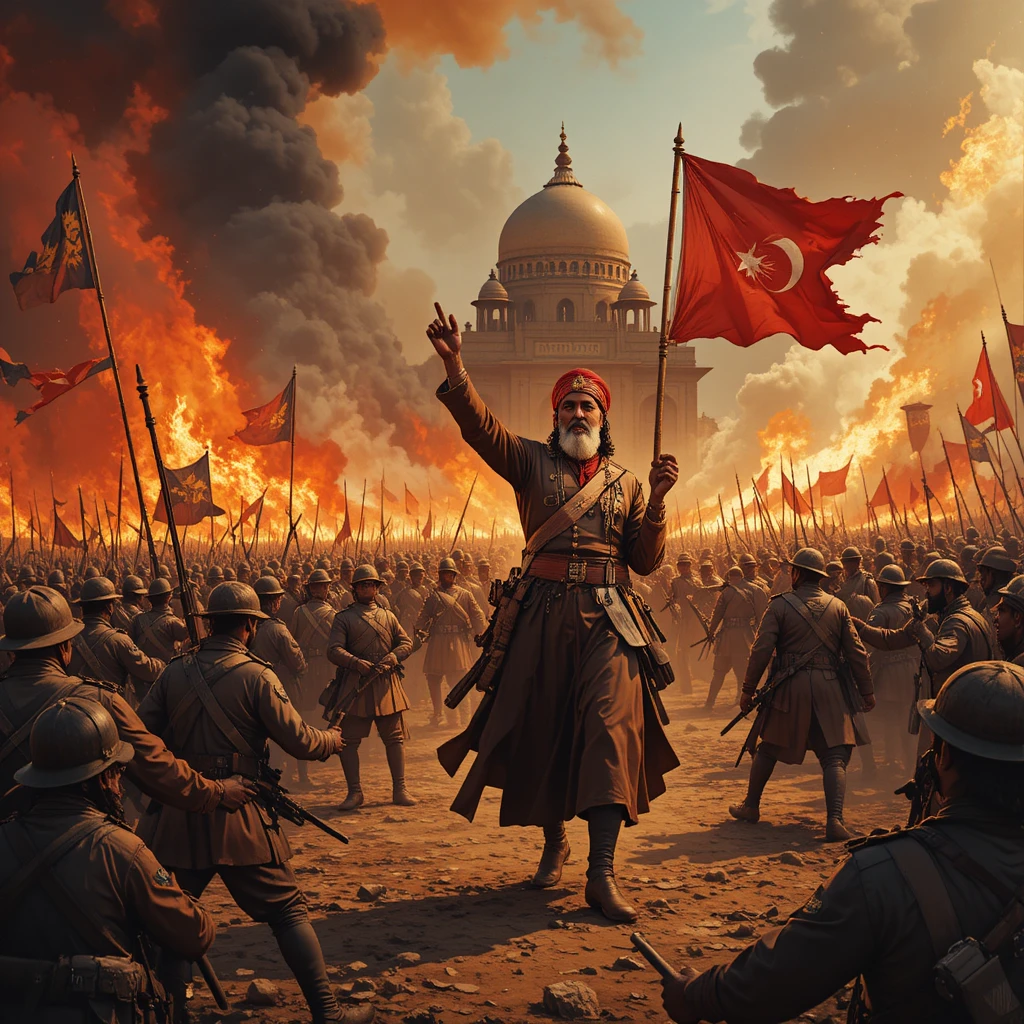
The revolt, often termed India’s First War of Independence, commenced on May 10, 1857, in Meerut, triggered by the arrest of sepoys who refused to use greased cartridges for the Enfield rifle. Rumors that the grease contained cow and pig fat offended Hindu and Muslim sentiments, symbolizing broader cultural insensitivities. The mutineers marched to Delhi, proclaiming Bahadur Shah II as emperor on May 11, igniting a widespread uprising across northern and central India.
Detailed Chronology of Key Battles and Events
In Delhi, the rebels held the city until September 1857, when British forces led by John Nicholson and Archdale Wilson recaptured it after a fierce siege, resulting in massive civilian casualties. Bahadur Shah was captured, tried, and exiled to Rangoon, marking the symbolic end of Mughal sovereignty. In Kanpur, Nana Sahib declared himself Peshwa on June 27, 1857, and besieged the British entrenchment under General Wheeler. After a surrender agreement, the tragic Bibighar Massacre occurred on July 15, where over 200 British captives were killed, prompting vengeful counter-atrocities by British troops under Henry Havelock and James Neill, who executed thousands indiscriminately.
Lucknow’s siege began on July 1, 1857, with the British Residency defended by Henry Lawrence (who died early) against forces led by Begum Hazrat Mahal. Relief attempts by Havelock in September and Colin Campbell in November involved intense urban warfare, with the final evacuation in March 1858. In Jhansi, Rani Lakshmibai assumed leadership after her husband’s death and the annexation of her state. She captured Jhansi fort in June 1857 and later allied with Tantia Tope, leading daring cavalry charges until her heroic death at Kotah-ki-Serai near Gwalior on June 17, 1858.
Central India’s campaign featured Tantia Tope’s mobile guerrilla tactics, capturing Gwalior in June 1858 before his betrayal and execution in April 1859. In Bihar, the octogenarian Kunwar Singh led a resilient revolt from Jagdispur, inflicting defeats on British forces until his death from wounds in April 1858. Other notable fronts included Awadh under Begum Hazrat Mahal, who proclaimed her son Birjis Qadr as ruler, and Rohilkhand under Khan Bahadur Khan.
The British response was draconian, employing scorched-earth tactics and summary executions, including the infamous “blowing from cannons.” Casualty figures remain debated: British losses around 6,000, Indian military deaths about 11,000, and civilian fatalities possibly exceeding 100,000, with some estimates suggesting up to 800,000 including famine-related deaths in affected areas.
Profiles of Prominent Leaders
Mangal Pandey (1827–1857), a sepoy in the 34th Bengal Native Infantry, initiated the Barrackpore mutiny on March 29, 1857, by attacking his officers. His execution on April 8 made him an enduring symbol of defiance. Rani Lakshmibai (1828–1858), originally Manikarnika Tambe, was educated in warfare and administration; her resistance embodied female empowerment in the struggle. Nana Sahib (1824–disappeared 1859), born Dhondu Pant, sought restitution for his adoptive father’s denied pension, leading operations with tactical acumen. Bahadur Shah II (1775–1862), a poet and patron of arts, reluctantly led the revolt, his court becoming a hub for rebel coordination despite his advanced age.
Begum Hazrat Mahal (1820–1879), regent of Awadh, coordinated with other leaders and issued proclamations appealing to Hindu-Muslim unity, fleeing to Nepal after defeat. Kunwar Singh (1777–1858), a Rajput zamindar, demonstrated strategic brilliance in guerrilla warfare despite his age.
Multifaceted Causes and Historiographical Debates
Immediate causes included the cartridge issue, but deeper roots lay in economic exploitation, political annexations, and cultural erosion. The revolt’s character—mutiny or national war?—has been debated: British historians like John Kaye labeled it a sepoy mutiny, while Karl Marx saw it as a national revolt in his 1857 New York Tribune articles. Indian nationalists, notably V.D. Savarkar in “The Indian War of Independence” (1909), portrayed it as a unified freedom struggle, though critics note its lack of pan-Indian coordination and class-based limitations.
Regional Variations and Societal Participation
The revolt was strongest in the Gangetic plain, Awadh, and central India, but weaker in the south due to prior suppressions like the Vellore Mutiny (1806) and Polygar Wars (1799–1805). Bengal’s intelligentsia provided ideological support through newspapers like the Hindoo Patriot. Women’s involvement was notable: besides Lakshmibai and Hazrat Mahal, figures like Jhalkari Bai (a Dalit warrior who impersonated the Rani) and Azizan Bai (a courtesan who aided rebels) highlighted gender diversity. Tribal groups in regions like Bihar participated, foreshadowing later movements.
Immediate Consequences and Long-Term Legacy
The revolt’s suppression led to the Government of India Act 1858, dissolving the East India Company and establishing direct Crown rule under Queen Victoria (proclaimed Empress in 1876). Army reforms increased the British-Indian ratio to 1:2 and segregated units. It fostered Hindu-Muslim unity, inspired socio-religious reforms, and sowed seeds for organized nationalism, influencing movements worldwide, including Ireland’s Easter Rising.
Socio-Religious Reforms: Ideological Precursors to Nationalism (1858–1885)
The post-revolt era saw intensified British control but also a renaissance in Indian thought. Raja Ram Mohan Roy (1772–1833), founder of the Brahmo Samaj in 1828, campaigned against sati (banned in 1829), child marriage, and polygamy, advocating women’s education and rationalism. His efforts culminated in the establishment of Hindu College (1817), precursor to Presidency University.
Dayananda Saraswati (1824–1883) founded the Arya Samaj in 1875, promoting Vedic purity, cow protection, and shuddhi (reconversion), influencing Punjab’s nationalist ethos. Ishwar Chandra Vidyasagar (1820–1891) pushed for widow remarriage, leading to the Hindu Widows’ Remarriage Act of 1856, and established schools for girls. Swami Vivekananda (1863–1902), disciple of Ramakrishna Paramahamsa, founded the Ramakrishna Mission in 1897, blending Vedanta with social service and representing India at the 1893 Chicago Parliament of Religions, boosting global Hindu pride.
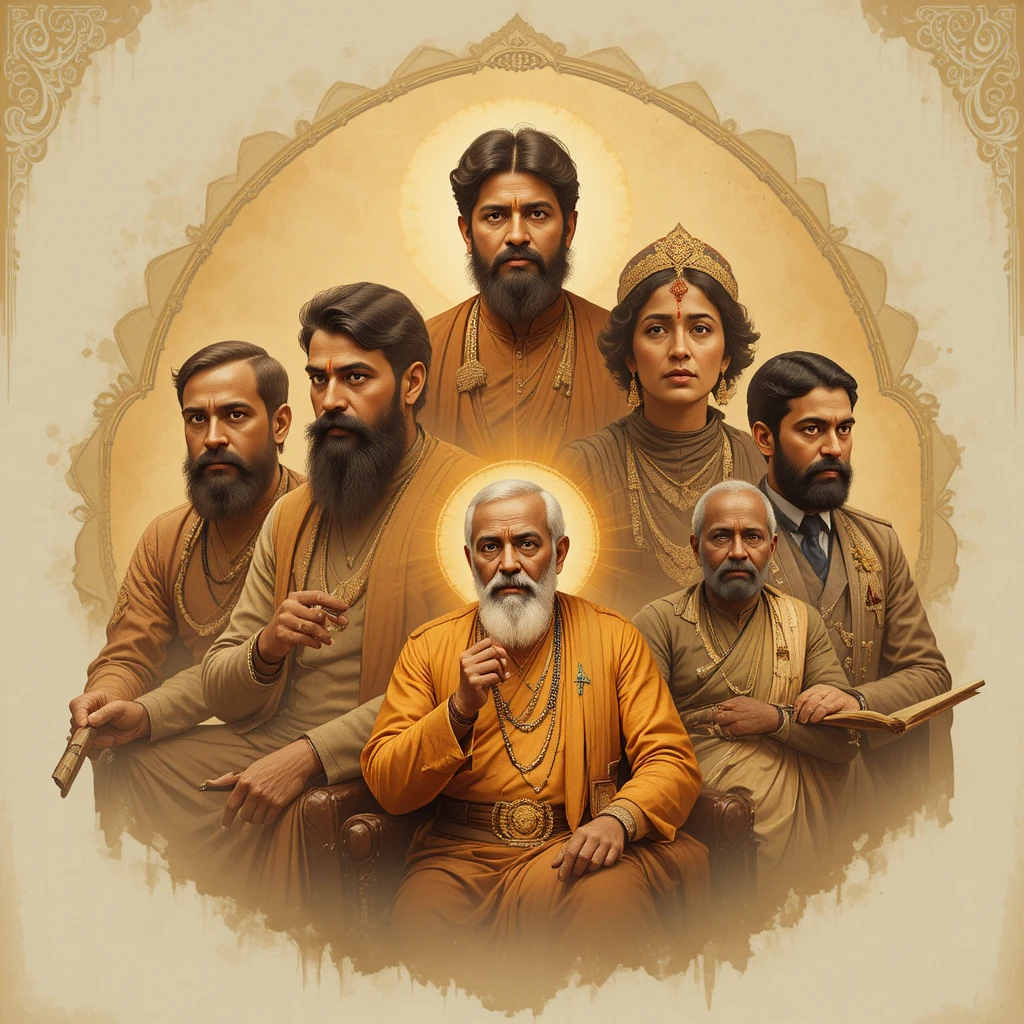
Muslim reformers like Sir Syed Ahmed Khan (1817–1898) established the Aligarh Movement in 1875, founding Muhammadan Anglo-Oriental College (later Aligarh Muslim University) to modernize Muslim education. These reforms critiqued colonialism indirectly, fostering a sense of cultural revival and unity essential for political mobilization.
The Genesis of Organized Nationalism: Indian National Congress (1885–1905)
The Indian National Congress (INC) was inaugurated on December 28, 1885, in Bombay with 72 delegates, under the presidency of Womesh Chunder Bonnerjee. Initiated by A.O. Hume as a platform for educated Indians to voice grievances, it initially adopted moderate tactics like petitions and resolutions.
Key figures included Dadabhai Naoroji, who in his 1901 book “Poverty and Un-British Rule in India” detailed the economic drain, estimating annual losses equivalent to India’s entire revenue. As the first Indian elected to the British Parliament in 1892, he advocated for Indian self-government. Surendranath Banerjee founded the Indian Association in 1876 and led protests against the Age of Consent Act (1891) and the Ilbert Bill dilution (1884), which allowed European judges to try Europeans, highlighting racial bias.
Gopal Krishna Gokhale, mentor to Gandhi, established the Servants of India Society in 1905 for selfless public service. Early INC sessions, like Allahabad (1888) and Calcutta (1896)—where Bankim Chandra Chatterjee’s “Vande Mataram” was first sung—focused on civil service reforms, reduction of military expenditure, and famine relief. The period saw the rise of economic nationalism, critiquing British policies that caused devastating famines (1896–1900, killing 19 million).
The Swadeshi Movement and Emergence of Extremism (1905–1911)
Lord Curzon’s partition of Bengal on October 16, 1905, divided the province along religious lines, provoking outrage as a “divide and rule” strategy. The Swadeshi Movement, launched at a Calcutta Town Hall meeting on August 7, 1905, promoted indigenous goods and boycotted British products, including public bonfires of foreign cloth.
The triumvirate of Lal-Bal-Pal—Lala Lajpat Rai, Bal Gangadhar Tilak, and Bipin Chandra Pal—spearheaded extremism. Tilak’s declaration “Swaraj is my birthright” in his newspapers Kesari and Maratha inspired masses. The movement included student strikes, national education initiatives like the Bengal National College, and cultural symbols like Raksha Bandhan for unity. The 1907 Surat Split divided moderates and extremists, with the latter advocating direct action.
Women’s participation grew, with Sarala Devi Chaudhurani organizing fitness clubs and Swarnakumari Devi promoting handicrafts. The partition was annulled in 1911, but it deepened communal divides and spread nationalism to other provinces.
Home Rule Leagues and World War I (1914–1919)
Annie Besant’s Home Rule League (1916) and Tilak’s parallel league demanded self-governance, mobilizing through pamphlets and lectures. The Lucknow Pact of 1916 allied INC and Muslim League for joint demands. World War I saw India contribute 1.3 million troops and £100 million, but post-war Montagu-Chelmsford Reforms (1919) introduced limited dyarchy, disappointing nationalists.
Gandhi’s Ascendancy: Non-Cooperation Movement (1919–1922)
Mohandas Karamchand Gandhi, after successful satyagrahas in Champaran (1917) against indigo planters, Kheda (1918) for tax relief, and Ahmedabad (1918) for mill workers, led the national stage. The Rowlatt Act and Jallianwala Bagh massacre (April 13, 1919, over 379 killed) propelled the Non-Cooperation Movement, launched August 1, 1920.
Allied with the Khilafat Movement, it involved boycotting elections, schools, courts, and foreign goods; charkha (spinning wheel) symbolized self-reliance. Participation surged, with women like Kasturba Gandhi and Sarojini Naidu leading. The Chauri Chaura incident (February 5, 1922) prompted suspension, but the movement democratized INC, increasing membership to millions.
Interlude: Simon Commission, Revolutionary Surge, and Purna Swaraj (1927–1930)
The all-British Simon Commission (1927), tasked with constitutional reforms but excluding Indians, faced nationwide boycotts with “Simon Go Back” slogans. During a protest in Lahore on October 30, 1928, Lala Lajpat Rai was severely injured by police lathi charges and died on November 17, 1928, galvanizing revolutionary youth against colonial brutality.
This period saw the rise of revolutionaries, with Bhagat Singh (1907–1931) emerging as a pivotal figure. Born in Punjab, Singh was influenced by the Ghadar Movement and socialist ideologies, including Marxism and anarchism. In 1926, he founded the Naujawan Bharat Sabha (Young India Society) to mobilize youth, peasants, and workers against imperialism, promoting atheism and social equality. He joined the Hindustan Republican Association (HRA) in 1924, which evolved into the Hindustan Socialist Republican Association (HSRA) in 1928 under his influence, emphasizing armed revolution and socialism.
To avenge Lajpat Rai’s death, Singh, along with Shivaram Rajguru, Sukhdev Thapar, and Chandrashekhar Azad, planned the assassination of police superintendent James Scott but mistakenly killed assistant superintendent John P. Saunders on December 17, 1928, in Lahore. This led to the Lahore Conspiracy Case. On April 8, 1929, Singh and Batukeshwar Dutt threw non-lethal bombs in the Central Legislative Assembly in Delhi to protest repressive laws like the Public Safety Bill and Trade Disputes Bill, shouting “Inquilab Zindabad” (Long Live the Revolution) and “Down with British Imperialism.” They allowed themselves to be arrested to use the trial as a platform to propagate their ideas, distributing pamphlets and delivering speeches on socialism and independence.
Singh’s writings, including “Why I Am an Atheist” (1930), critiqued religion and colonialism, inspiring generations. Despite global appeals for clemency, he, Rajguru, and Sukhdev were executed on March 23, 1931, at Lahore Central Jail, becoming martyrs (shaheeds) and symbols of fearless resistance. His actions radicalized youth, bridged revolutionary and mainstream nationalism, and pressured the INC towards more assertive demands.
The revolutionary fervor, coupled with economic depression, culminated in the INC’s Lahore Session (December 1929), presided over by Jawaharlal Nehru, which declared Purna Swaraj (complete independence) on January 26, 1930, celebrated as Independence Day until 1947.
Civil Disobedience Movement: Defiance and Dialogue (1930–1934)
Gandhi’s 240-mile Dandi March (March 12–April 6, 1930) defied the salt monopoly, inspiring nationwide violations and 60,000 arrests. Regional highlights included Khan Abdul Ghaffar Khan’s non-violent Pathans in NWFP and the Dharasana raid (May 21, 1930). Women like Naidu and Chattopadhyay led boldly.
The Gandhi-Irwin Pact (1931) led to Round Table Conferences, but failures resumed the movement. The 1932 Communal Award and Poona Pact addressed depressed classes’ representation.
Socialist Currents and Electoral Politics (1934–1939)
Nehru’s socialist vision influenced INC sessions; Bose’s 1938–1939 presidencies advocated industrialization. The 1935 Government of India Act enabled 1937 elections, where INC won majorities in 8 provinces, implementing reforms like debt relief.
World War II: Quit India and Militant Alternatives (1939–1945)
Britain’s war declaration led to ministerial resignations. The 1942 Cripps Mission failed; Quit India (August 8, 1942) saw “Do or Die” calls, mass arrests, and underground resistance by Narayan and Ali.
Bose’s INA, formed 1942, with Japanese support, included the women’s Rani of Jhansi Regiment. INA trials (1945) ignited protests.
The Role of Princely States in the Freedom Movement
The princely states, numbering over 562 and covering 40% of India’s territory, played a complex and ambivalent role in the freedom struggle. Under British paramountcy, these semi-autonomous entities were governed by hereditary rulers who enjoyed internal sovereignty in exchange for loyalty to the Crown. While many princes suppressed nationalist activities within their domains—banning INC meetings, censoring press, and arresting activists—others provided covert support or sympathized with the cause. For instance, during the 1857 Revolt, states like Jhansi and Awadh actively rebelled, with rulers like Rani Lakshmibai and Begum Hazrat Mahal leading charges. In the early 20th century, the All India States People’s Conference (AISPC), founded in 1927 under INC guidance, mobilized for democratic rights in these states, with Nehru as its president from 1939.
Popular movements erupted in states like Mysore (1930s temple entry campaigns), Travancore (1938 State Congress agitation), and Hyderabad (1938 satyagraha against the Nizam). Some rulers, like the Maharaja of Baroda (Sayajirao Gaekwad III), promoted education and reforms, indirectly aiding nationalism by employing figures like Aurobindo Ghose. However, most aligned with Britain, providing troops during wars and receiving gun salutes and privy purses as rewards. The INC, influenced by Gandhi, initially avoided direct intervention but by the 1930s demanded representative institutions and civil liberties in these states. Post-1947, the integration of princely states—masterminded by Patel through diplomacy, Instrument of Accession, and occasional force (e.g., Hyderabad’s Operation Polo in 1948)—was crucial, preventing balkanization and consolidating the republic. This process, while largely peaceful, involved negotiations with resistant states like Junagadh and Kashmir, underscoring the princely states’ pivotal transition from colonial allies to integral parts of sovereign India.
Climax: Mutinies, Partition, and Independence (1946–1947)
The 1946 RIN Mutiny and communal riots accelerated British exit. The Cabinet Mission’s federal plan failed; Direct Action Day sparked violence. Mountbatten’s June 3, 1947, plan partitioned India, creating Pakistan. Independence on August 15, 1947, amid tragedy: 14-18 million displaced, 1-2 million dead.
The Constitutional Framework: Republic Day (1946–1950)
The Constituent Assembly, with Ambedkar drafting, adopted the Constitution on November 26, 1949, effective January 26, 1950. It incorporated universal suffrage, federalism, and rights, drawing from global models.
Reflections: Global Impact and Enduring Challenges
This struggle inspired anti-colonial movements in Asia and Africa. Yet, partition’s legacies—communal tensions, refugee crises—persist. The ethos of satyagraha and unity remains vital.