
An In-Depth Historical and Architectural Exploration
Executive Summary
Delhi, the capital of India, stands as one of the world’s oldest continuously inhabited cities with a recorded history spanning over 3,000 years. This ancient metropolis has witnessed the rise and fall of numerous empires, each leaving an indelible mark on its landscape through magnificent monuments, forts, tombs, and religious structures. From the mythological city of Indraprastha mentioned in the Mahabharata to the modern capital of the world’s largest democracy, Delhi’s architectural heritage represents an extraordinary fusion of Hindu, Islamic, Persian, and British colonial influences. Today, Delhi is home to three UNESCO World Heritage Sites and hundreds of protected monuments that attract millions of visitors annually, making it one of the most important heritage destinations in the world.
Introduction: The City of Seven Cities
Delhi’s unique identity stems from its status as a city built, destroyed, and rebuilt multiple times throughout history. Colonial historians drew parallels between the seven hills of Rome and the seven cities of Delhi, each constructed by different dynasties who made this strategic location their capital. The city’s position on the Uttarapatha trade route, which connected the Gangetic plains to the Silk Route, combined with its natural defenses provided by the Yamuna River and the Aravalli Hills, made Delhi an irresistible prize for conquering rulers.
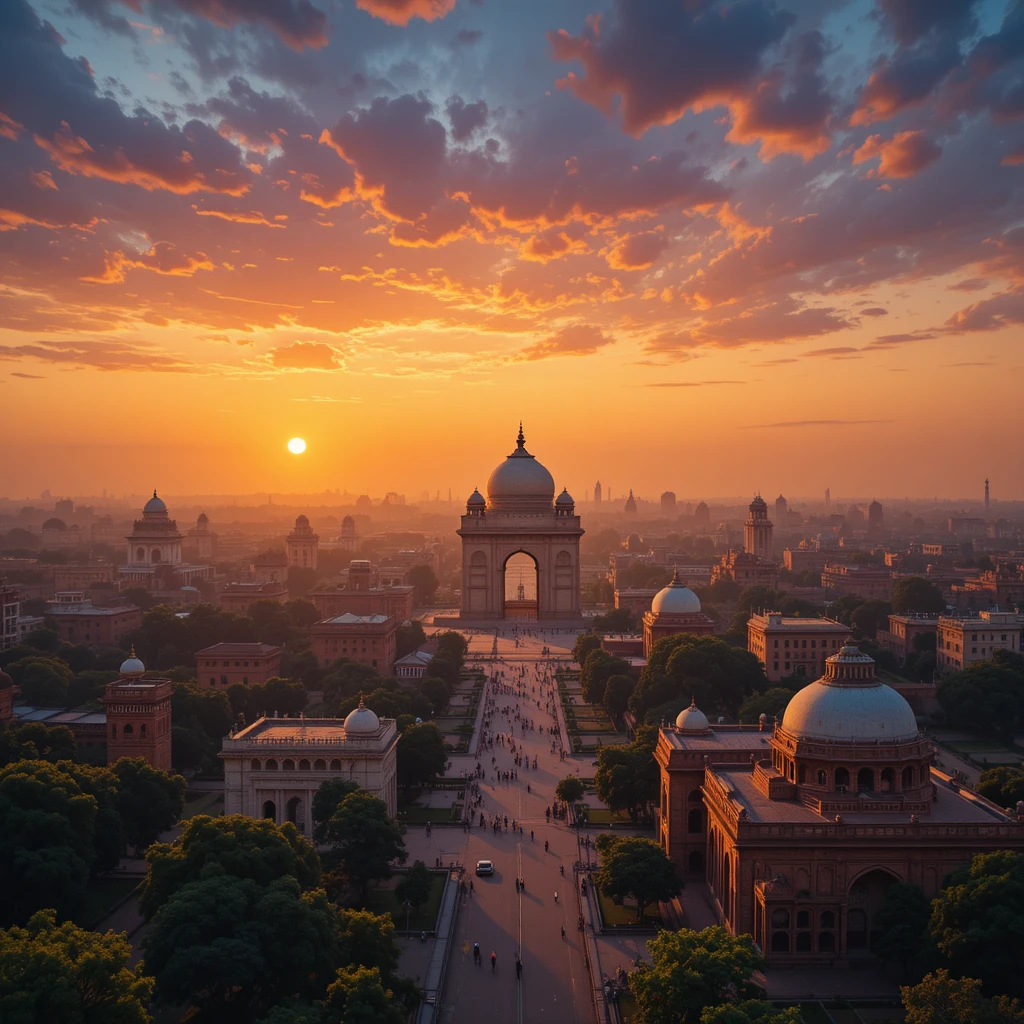
Table of Contents
Archaeological excavations, particularly at Purana Qila, have revealed continuous cultural layers from the 3rd-4th century BCE through the Mauryan, Shunga, Kushana, Gupta, Rajput, Delhi Sultanate, and Mughal periods. Painted Grey Ware pottery dating to approximately 1000 BCE provides tangible evidence of Delhi’s ancient origins, linking it to the legendary city of Indraprastha mentioned in the epic Mahabharata.
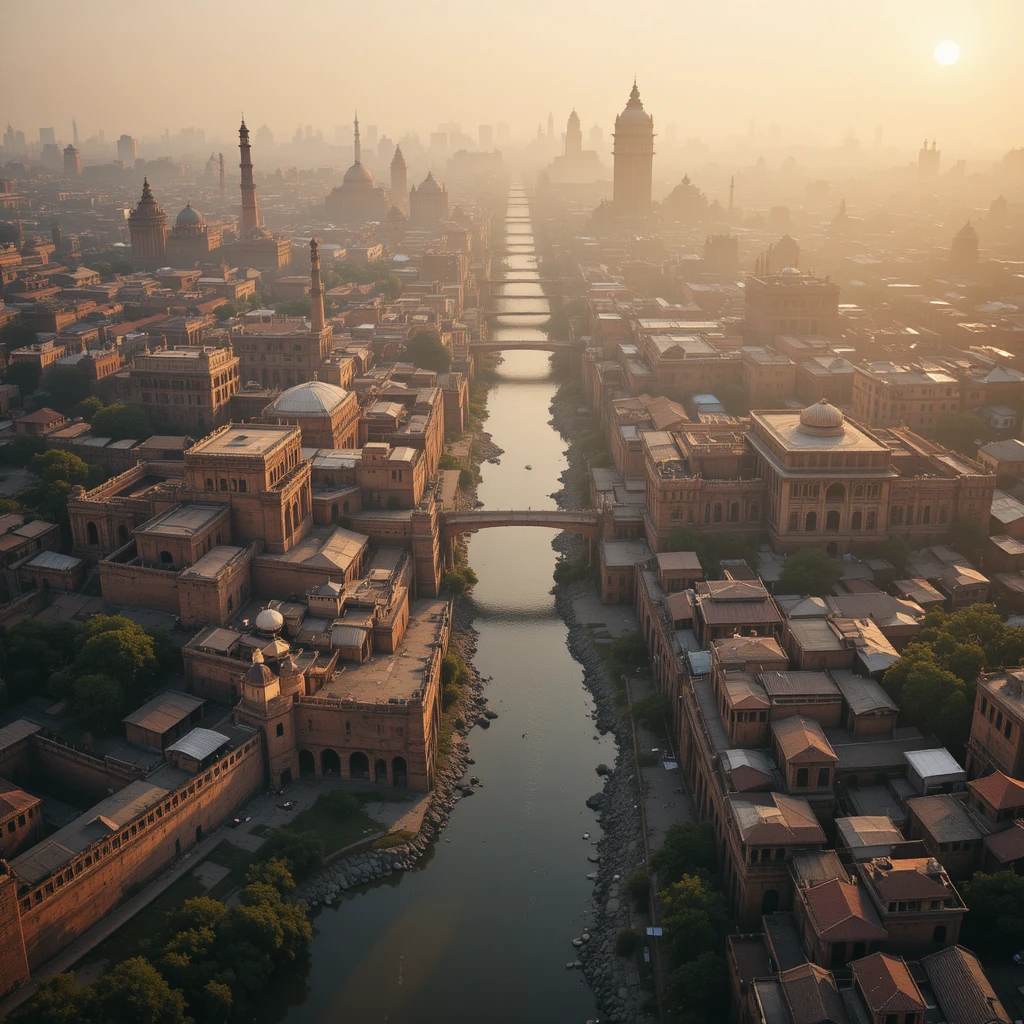
This comprehensive article explores Delhi’s monuments chronologically, examining their historical context, architectural significance, and cultural impact. We will journey through the seven historical cities, investigate the three UNESCO World Heritage Sites, and discover the lesser-known gems that collectively tell the story of India’s evolution from ancient kingdoms to modern nationhood.
The Seven Historic Cities of Delhi
1.1 Qila Rai Pithora (Lal Kot) – The First City (11th-12th Century)
The first historically documented city of Delhi, Lal Kot, was established around 1052 CE by Anangpal Tomar II of the Rajput Tomar dynasty. This fortified settlement, constructed with rubble masonry, served as the nucleus of Delhi’s recorded history. In the 12th century, the Chauhan Rajputs under Prithviraj Chauhan conquered Lal Kot and expanded it, renaming it Qila Rai Pithora.
Prithviraj Chauhan’s reign marked the last period of Hindu rule in Delhi before the Islamic conquest. The Second Battle of Tarain in 1192 CE proved decisive when Muhammad Ghori defeated Prithviraj, initiating seven centuries of Islamic rule in northern India. Ghori’s trusted general, Qutb-ud-din Aibak, established the Mamluk (Slave) Dynasty and transformed Qila Rai Pithora into the capital of the Delhi Sultanate.
The most significant monument from this period is the Qutub Minar complex, which Qutb-ud-din Aibak began constructing in 1192. The complex encompasses the world’s tallest brick minaret, the Quwwat-ul-Islam Mosque (the oldest surviving mosque in northern India), and numerous other structures that showcase the transition from Hindu to Islamic architecture. Today, remnants of Qila Rai Pithora’s 6.5-kilometer-long fortification walls can still be found across South Delhi’s Vasant Kunj, Kishangarh, Mehrauli, and Saket areas.
1.2 Siri – The Second City (Early 14th Century)
Alauddin Khilji of the Khilji Dynasty constructed Siri around 1303 CE as a defensive fortification against repeated Mongol invasions that threatened Delhi. The name “Siri” possibly derives from the severed heads (sir) of Mongol soldiers that were allegedly displayed on the fort’s walls as a warning to future invaders.
While much of Siri has vanished beneath modern development, significant remnants survive including the Siri Fort ruins and the Hauz Khas complex. Hauz Khas, meaning “Royal Tank,” features a water reservoir built by Alauddin Khilji and later enhanced by Firoz Shah Tughlaq. The area today contains medieval monuments, tombs, and a madrasa, offering glimpses into Delhi’s Islamic scholarly traditions.
1.3 Tughlaqabad – The Third City (1321-1325)
Ghiyasuddin Tughlaq founded Tughlaqabad in 1321 as a massive fortified city that would symbolize Tughlaq power and ambition. Constructed rapidly on the rocky Aravalli Hills in South Delhi, Tughlaqabad featured impressive multi-tiered sloping fortifications rising to heights of 25 meters, impregnable bastions, large granaries, water reservoirs, and subterranean storage rooms for ammunition and treasures.
The city’s architecture introduced the distinctive Tughlaq style characterized by sloping rubble-filled walls and fortress-like structures. However, Tughlaqabad’s glory was short-lived. A bitter conflict between Ghiyasuddin and the revered Sufi saint Nizamuddin Auliya culminated in the saint’s famous curse: “Ya basse gujjar, ya rahe ujjar” (May Tughlaqabad either be occupied by nomads or remain forever barren). When Ghiyasuddin was allegedly assassinated by his son Muhammad bin Tughlaq in 1325 under the guise of a celebration invitation, the city was abandoned.
Today, Tughlaqabad stands as haunting ruins, its massive stone fortifications and the Mausoleum of Ghiyasuddin Tughlaq (connected to the fort by a causeway) serving as reminders of both the dynasty’s ambition and the impermanence of power. The site spans over six square kilometers, making it one of Delhi’s largest ruined cities.
1.4 Jahanpanah – The Fourth City (Mid-14th Century)
Muhammad bin Tughlaq, known for his eccentric policies and ambitious projects, established Jahanpanah (“Refuge of the World”) with the grand vision of uniting the earlier cities of Lal Kot, Siri, and Tughlaqabad within a single fortified enclosure. Located in present-day Khirki and Begumpur areas, Jahanpanah covered a vast area intended to be the grandest of all Delhi’s cities.
Despite its ambitious scale, Jahanpanah’s plan was never fully realized. The most significant surviving structures include the Begumpur Mosque and Khirki Mosque, both built during Muhammad bin Tughlaq’s reign and representing important examples of early congregational mosques. These structures showcase innovative architectural features, including the Khirki Mosque’s unique closed design with a central courtyard, unusual for Indian mosques of that period.
The city declined soon after Muhammad bin Tughlaq’s death, and today only remnants of fort walls, bastions, and gateways remain scattered throughout the area, testament to an unfulfilled vision of urban grandeur.
1.5 Firozabad – The Fifth City (1351-1388)
Firoz Shah Tughlaq, unlike his militaristic predecessors, focused on public welfare and infrastructure development. He established Firozabad (also known as Firoz Shah Kotla) along the banks of the Yamuna River, north of the older settlements. The city was known for its palaces featuring pillared halls and high walls, mosques, a distinctive pigeon tower (Kabootar Khana), water tanks, and the remarkable transplantation of a 1,500-year-old Ashokan pillar from Topra in Haryana.
Firoz Shah built numerous hunting lodges and mosques around Delhi and undertook extensive restoration work on earlier monuments including Sultan Ghori’s Tomb, Qutub Minar, Suraj Kund, and Hauz Khas. His own tomb lies in Hauz Khas. The Kotla Firoz Shah complex remains partially intact, though today it’s better known as a sports stadium. Firozabad marked a period of architectural innovation and urban planning that contrasted sharply with the fortress mentality of earlier Tughlaq constructions.
The Sayyid and Lodi dynasties that followed the Tughlaqs contributed little to Delhi’s architectural legacy, with the notable exception of the beautiful tombs in Lodi Gardens, which showcase the evolution of Indo-Islamic funerary architecture.
1.6 Dinpanah/Shergarh (Purana Qila) – The Sixth City (1533-1556)
The Mughal Emperor Humayun founded Dinpanah (“Refuge of the Faith”) around 1533 CE near the site believed to be ancient Indraprastha. This location held profound mythological significance as the legendary capital of the Pandavas from the Mahabharata. Archaeological excavations have revealed Painted Grey Ware pottery and Northern Black Polished Ware, confirming settlement from approximately 1000 BCE through successive historical periods.
When Sher Shah Suri defeated Humayun in 1540, he expanded and renamed the site Shergarh, adding robust fortifications, gates, and buildings. The ornate Purana Qila (Old Fort) that stands today represents a collaborative creation of both rulers, showcasing transitional architecture between the Lodis and early Mughals.
The fort’s architectural highlights include three massive gates: Bada Darwaza (Western Gate), Humayun Darwaza (Southern Gate), and Talaqi Darwaza (Forbidden or Northern Gate). The Qila-i-Kuhna Mosque, built by Sher Shah, displays exquisite use of red sandstone and white marble, anticipating the later Mughal style. Sher Mandal, a two-storeyed octagonal tower, gained tragic fame as the place where Humayun met his death after falling from its stairs in 1556.
On October 7, 1556, the Hindu king Hem Chandra Vikramaditya (Hemu), who had defeated Akbar’s forces at the Battle of Delhi, was crowned in Purana Qila, briefly establishing Hindu rule. The Mughals decisively defeated Hemu one month later at the Second Battle of Panipat. Edwin Lutyens, when designing New Delhi in the 1920s, aligned the central vista (now Rajpath) with the Humayun Darwaza, physically and symbolically linking British India’s new capital to Delhi’s ancient heritage.
1.7 Shahjahanabad (Old Delhi) – The Seventh City (1638-1648)
Emperor Shah Jahan, the fifth Mughal emperor renowned for commissioning the Taj Mahal, founded Shahjahanabad in 1638 after moving his capital from Agra to Delhi. This planned city represented the pinnacle of Mughal urban design and architectural achievement. Shahjahanabad was enclosed by massive walls approximately 2.4 kilometers in circumference and featured fourteen main gates, of which notable survivors include Kashmiri Gate, Delhi Gate, Ajmeri Gate, and Turkman Gate.
The Red Fort (Lal Qila), built between 1638 and 1648, served as the walled citadel and main residence of Mughal emperors for nearly 200 years. Constructed from red sandstone, the fort complex encompasses palaces, audience halls, mosques, gardens, and museums. The fort housed the legendary Peacock Throne until it was plundered by Persian invader Nadir Shah in 1739. Significant surviving structures include the Lahori Gate (the main entrance), Diwan-i-Aam (Hall of Public Audience), Diwan-i-Khas (Hall of Private Audience), Rang Mahal (Palace of Colors), Mumtaz Mahal, and the personal mosque Moti Masjid built by Aurangzeb.
The Jama Masjid, another of Shah Jahan’s masterpieces, was constructed between 1650 and 1656 at the highest point of Shahjahanabad. As India’s second-largest mosque, it can accommodate up to 25,000 worshippers in its spacious courtyard. The mosque features three large gates, four towers, and two 40-meter-high minarets constructed from red sandstone and white marble. The central courtyard, paved with red sandstone, contains a marble ablution tank and is surrounded by open arcades providing views of Old Delhi.
Shahjahanabad’s commercial heart was Chandni Chowk, one of Asia’s oldest and busiest markets, which remains vibrant today. The walled city’s urban morphology largely survived intact despite the traumatic events of the 1857 Uprising when British forces severely damaged parts of Old Delhi. Today, Shahjahanabad (Old Delhi) continues as a living historical city where medieval street patterns coexist with modern commerce, and where monuments stand amid bustling markets and residential neighborhoods.
UNESCO World Heritage Sites in Delhi
Delhi proudly houses three UNESCO World Heritage Sites, each recognized for its outstanding universal value, architectural brilliance, and historical significance. These monuments represent different periods of Delhi’s history and showcase the evolution of Indo-Islamic architecture from the 13th to the 17th centuries.
2.1 Qutub Minar and its Monuments (UNESCO Designation: 1993)
The Qutub Minar complex represents the earliest phase of Indo-Islamic architecture in India and serves as a symbol of Delhi itself. Built in the early 13th century, just a few kilometers south of Delhi, this remarkable complex exemplifies the fusion of Islamic, Persian, and indigenous Indian architectural traditions.
The Qutub Minar Tower:
The centerpiece minaret stands 72.5 meters (238 feet) high, making it the world’s tallest brick minaret. The tower tapers dramatically from 14.32 meters in diameter at its base to 2.75 meters at its peak, and features five distinct storeys, each marked by balconies. The lower three storeys are constructed of red sandstone, while the upper two use marble and sandstone.
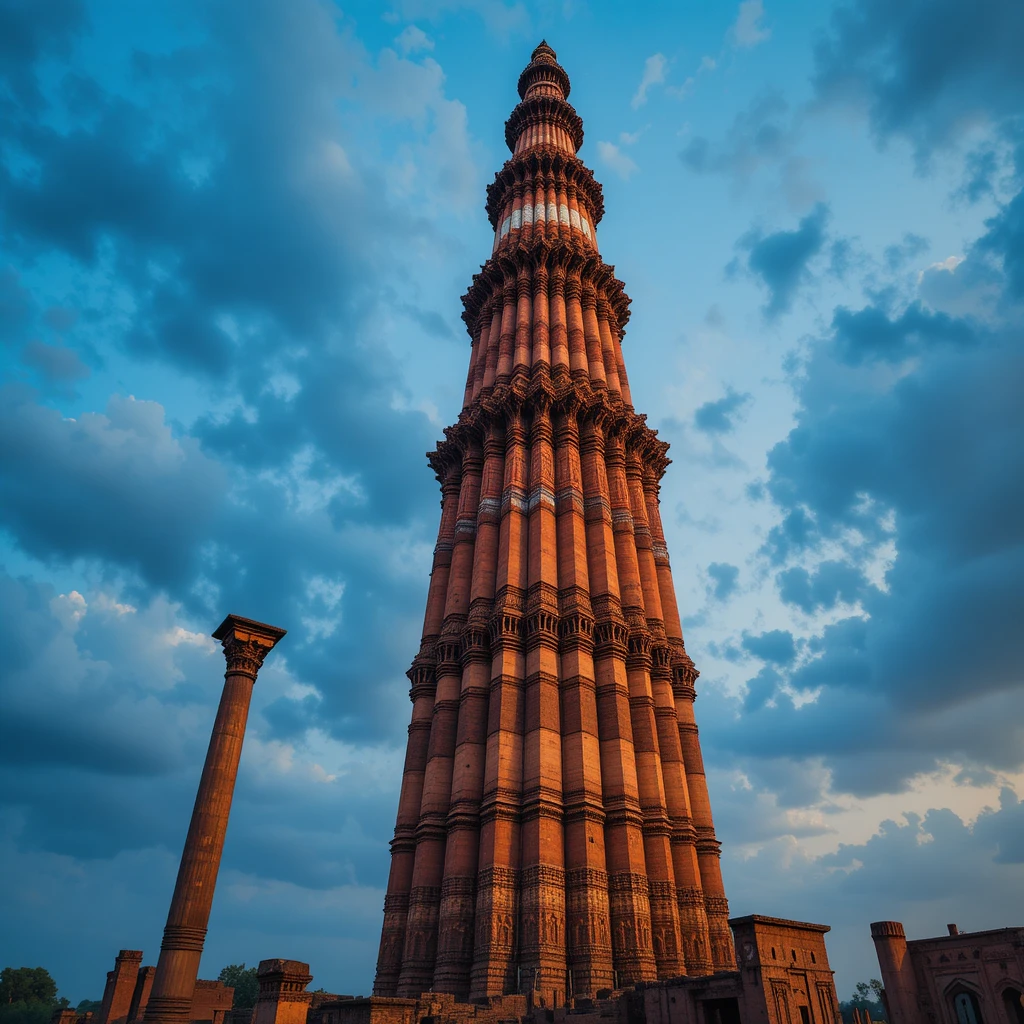
The architectural design alternates between angular and rounded fluting, creating a striking visual effect. The entire surface is covered with intricate Islamic calligraphy, verses from the Quran, and arabesque patterns. Qutb-ud-din Aibak began construction in 1192, completing only the first storey before his death in 1210. His successor Iltutmish added three more storeys, and Firoz Shah Tughlaq rebuilt the top two storeys after they were damaged by lightning in 1369.
Quwwat-ul-Islam Mosque:
The “Might of Islam” mosque is the oldest surviving mosque in northern India. Built on the site of demolished Hindu and Jain temples, it incorporates materials from approximately 27 temples, creating a fascinating architectural hybrid. Hindu and Jain craftsmen, working for their new Muslim rulers, brought their traditional decorative motifs and construction techniques to Islamic structures. The mosque features a remarkable iron pillar dating from the 4th-5th century CE (predating the mosque by over 700 years), renowned for its rust-resistant composition – a metallurgical achievement that continues to intrigue scientists.
Alai Darwaza:
Constructed in 1311 by Alauddin Khilji, this magnificent gateway is considered a masterpiece of Indo-Muslim art. It was intended as the southern entrance to an enlarged mosque complex. The structure showcases perfected proportions, innovative use of red sandstone and white marble, and sophisticated decorative elements including latticed stone screens (jaalis) and calligraphic inscriptions.
Alai Minar:
This unfinished tower represents Alauddin Khilji’s ambition to construct a minaret twice the height of the Qutub Minar. Only the base was completed before his death in 1316, creating one of Delhi’s most intriguing “what might have been” monuments.
The complex also contains several tombs, including those of Iltutmish and Alauddin Khilji, plus additional Islamic monuments built over subsequent centuries. The Archaeological Survey of India maintains the site through comprehensive conservation efforts, and it receives millions of visitors annually who come to witness this extraordinary testament to Delhi’s transformation from a Hindu-Jain religious center to an Islamic sultanate capital.
2.2 Humayun’s Tomb (UNESCO Designation: 1993)
Humayun’s Tomb represents a revolutionary moment in Indian architectural history – the first garden-tomb ever built on the Indian subcontinent and the architectural precursor to the Taj Mahal. Commissioned in 1562 by Empress Bega Begum (Haji Begum), the first wife and chief consort of the Mughal Emperor Humayun, the tomb was designed by Persian architects Mirak Mirza Ghiyas and his son Sayyid Muhammad.
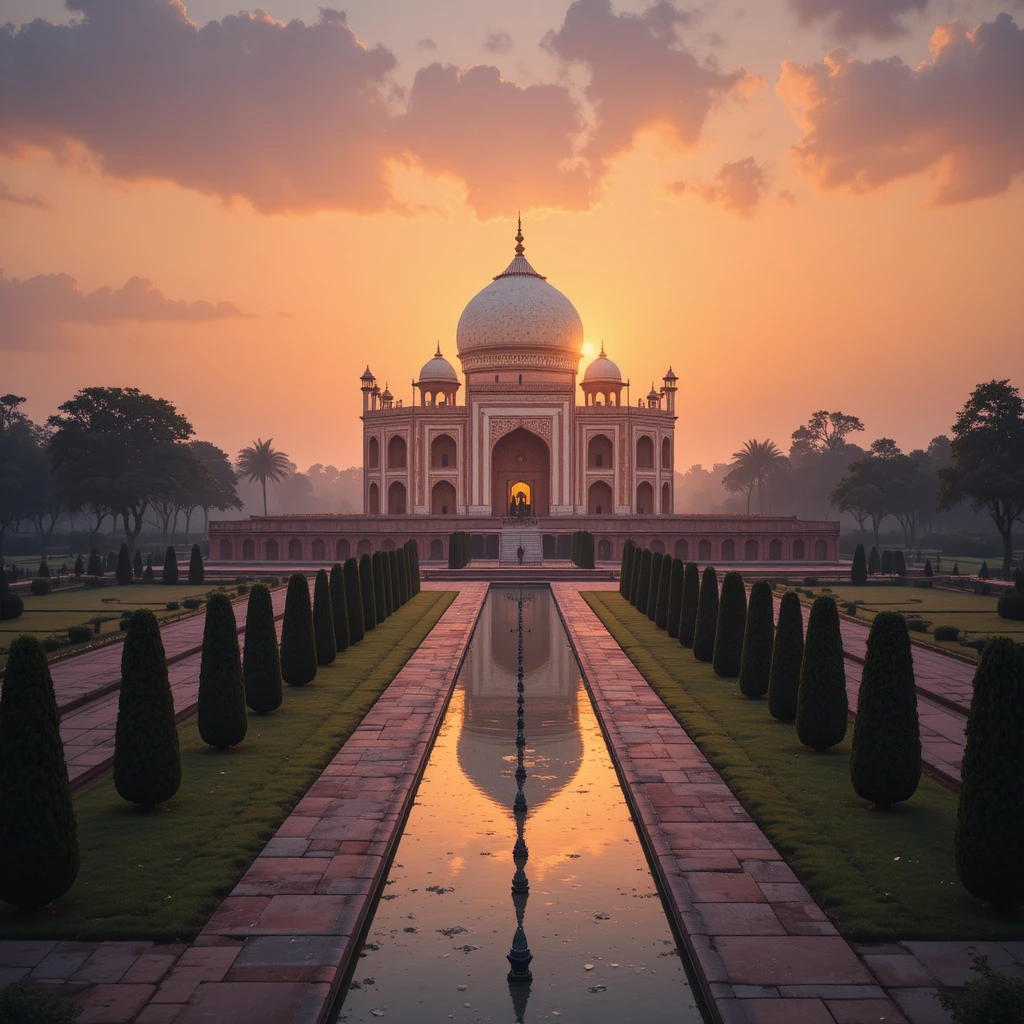
The design drew inspiration from the Gur-e Amir, the tomb of Timur (Humayun’s ancestor) in Samarkand, and introduced the concept of the Persian char bagh (four-quadrant garden) to India. This paradise garden concept, based on the Quranic description of paradise as containing four rivers, became the template for Mughal garden design throughout the empire. The garden complex covers 30 acres and is divided into four main quadrants by walkways and water channels that meet at a central raised platform where the main tomb stands.
Architectural Features:
The octagonal tomb structure stands on a high platform approximately 7 meters above the garden. Constructed from red sandstone with white and black marble detailing, it measures about 47 meters square and reaches a height of 47 meters including the dome. The central chamber houses Humayun’s cenotaph, while the actual grave lies in a chamber directly below. The structure features double-storied arched alcoves on each side, creating a complex interplay of solid and void.
The massive white marble dome, surmounted by a brass finial with a crescent, creates an impressive silhouette against the Delhi sky. The dome’s design introduces the concept of the double dome to India – an outer structural dome and an inner decorated ceiling at different heights – a technique perfected in later Mughal architecture.
The Complex:
The complex contains over 150 graves of Mughal royalty and their relatives, earning it the nickname “Dormitory of the Mughals.” Other significant structures include: Isa Khan’s Tomb (built 1547-48, predating the main tomb), a beautiful octagonal tomb set within its own garden enclosure; the Tomb of Humayun’s wife Hamida Banu Begum; the Tomb of Humayun’s barber (Nai-ka-Gumbad); the Arab Serai; the Afsarwala Tomb and Mosque; and Bu Halima’s Garden. The recently restored adjacent Sunder Nursery offers a 90-acre extension to the heritage complex.
Historical Significance:
During the 1857 Rebellion, the last Mughal emperor Bahadur Shah Zafar took refuge here before his capture by the British. During Partition in 1947, the tomb and gardens became a refugee camp for Muslims migrating to Pakistan, with over 150,000 people camping here for five years. A joint conservation project between the Archaeological Survey of India and the Aga Khan Trust for Culture has restored the gardens and monuments to their original splendor, making Humayun’s Tomb one of the best-maintained World Heritage Sites in India.
2.3 Red Fort Complex (UNESCO Designation: 2007)
The Red Fort (Lal Qila) represents the zenith of Mughal creativity and power, serving as the residence of Mughal emperors for nearly 200 years. Built by Emperor Shah Jahan between 1638 and 1648 when he relocated the Mughal capital from Agra to Delhi, the fort derives its name from the massive red sandstone walls that enclose it.
Layout and Architecture:
The octagonal fort covers approximately 254 acres and is surrounded by walls varying from 18 to 33 meters in height. The fortifications extend 2.4 kilometers in circumference and are protected by a deep moat connected to the Yamuna River. Two main gates provide access: the Lahori Gate (facing Lahore, now the main public entrance) and the Delhi Gate (facing the city).
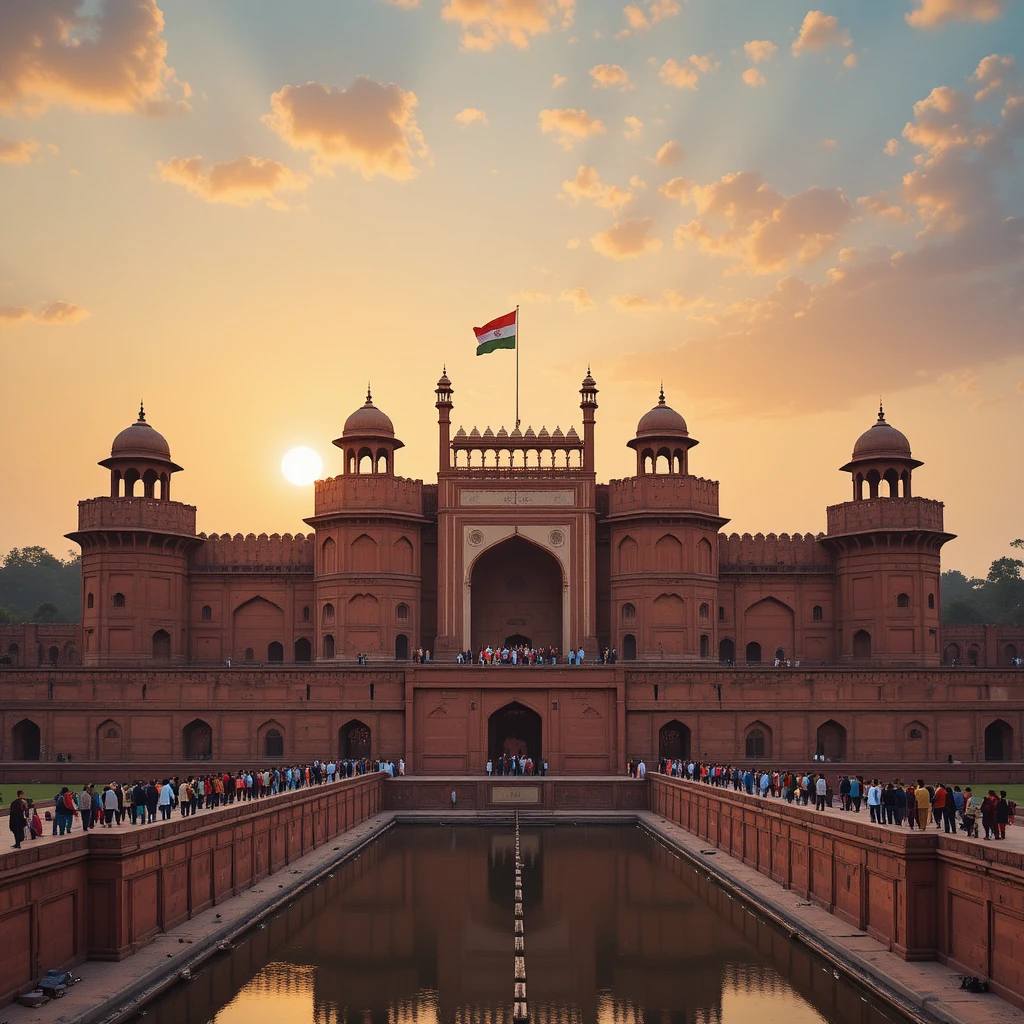
Beyond the Lahori Gate lies the Chatta Chowk (Covered Bazaar), a 540-meter-long vaulted arcade originally filled with shops selling luxury goods for the court. The arcade leads to the Naubat Khana (Drum House), where musicians played for the emperor. No one except the emperor could ride beyond this point – all others, including princes and nobles, had to dismount and proceed on foot.
Principal Structures:
The Diwan-i-Aam (Hall of Public Audience) features a colonnaded hall where the emperor heard petitions from common subjects. The Diwan-i-Khas (Hall of Private Audience) represents the most exquisite building in the fort, with ornately carved marble pillars and precious stone inlay work. It once housed the legendary Peacock Throne, which was plundered by Persian invader Nadir Shah in 1739. Above the central marble arch, a Persian inscription reads: “If there is paradise on earth, it is this, it is this, it is this.”
The Rang Mahal (Palace of Colors) served as the residence of the emperor’s wives and mistresses, featuring a central marble lotus-shaped fountain. The Mumtaz Mahal, named after Shah Jahan’s beloved wife (for whom he built the Taj Mahal), now houses the Red Fort Archaeological Museum. The Khas Mahal was the emperor’s private palace, comprising three pavilions with marble screens overlooking the Yamuna River.
The Moti Masjid (Pearl Mosque), built by Emperor Aurangzeb in 1659, is a white marble mosque meant for the emperor’s personal use. The Hayat Baksh Bagh (Life-Bestowing Garden) showcases the Mughal love of landscaped gardens with water channels and pavilions.
Historical Events:
The Red Fort witnessed numerous historical events. Nadir Shah’s 1739 invasion resulted in massive plunder including the Peacock Throne and the Koh-i-Noor diamond. Following the 1857 Rebellion, the British severely damaged the fort, destroyed several buildings, and used it as a military garrison. The last Mughal emperor, Bahadur Shah Zafar, was tried here before being exiled to Rangoon. On August 15, 1947, Jawaharlal Nehru raised the Indian flag at the Red Fort, marking India’s independence. Since then, every Prime Minister has delivered an Independence Day address from the Lahori Gate’s ramparts. The fort now houses several museums and hosts a nightly sound and light show depicting Delhi’s history.
Other Notable Monuments and Heritage Sites
Beyond the UNESCO sites, Delhi contains hundreds of monuments spanning different eras and architectural styles. These structures collectively narrate Delhi’s transformation from ancient settlements to the modern capital of the world’s largest democracy.
3.1 India Gate
India Gate stands as Delhi’s most iconic war memorial, designed by Sir Edwin Lutyens and completed in 1931. The 42-meter-tall (138-foot) arch commemorates 70,000 soldiers of the British Indian Army who died during World War I and the Third Anglo-Afghan War. The names of over 13,000 servicemen, including British and Indian soldiers, are inscribed on the monument’s surfaces.
Inspired by the Arc de Triomphe in Paris, India Gate’s design blends classical and modern architectural elements. After India’s independence, it became the nation’s memorial to soldiers killed in various conflicts. The Amar Jawan Jyoti (Eternal Flame), lit in 1972 beneath the arch, honors soldiers who sacrificed their lives in the 1971 Indo-Pakistani War. In 2022, the flame was merged with the flame at the National War Memorial behind India Gate. The monument stands at the eastern end of Rajpath, forming part of Lutyens’ grand vista that extends to Rashtrapati Bhavan.
3.2 Jantar Mantar
Constructed in 1724 by Maharaja Jai Singh II of Jaipur, Jantar Mantar represents one of five astronomical observatories built by this enlightened ruler. The name derives from the Sanskrit words ‘Yantra’ (instrument) and ‘Mantra’ (formula or calculation). Unlike typical observatories, these instruments are constructed entirely from masonry materials – stone, brick, and marble – rather than metal or glass.
Key Instruments:
The Samrat Yantra (Supreme Instrument) is a massive equinoctial sundial standing 70 feet high with a 114-foot base and 10-foot thickness. Its 128-foot hypotenuse aligns parallel to the Earth’s axis, pointing toward the North Pole. This giant triangle can calculate local time with accuracy up to two seconds, making it one of the world’s most precise sundials.
The Jai Prakash Yantra consists of concave and convex hemispherical bowls used for observing celestial bodies’ positions. The Ram Yantra comprises two cylindrical structures with open tops and graduated scales for measuring altitude and azimuth of celestial objects. The Misra Yantra combines features of multiple instruments for various astronomical calculations.
While modern tall buildings surrounding the complex have compromised some instruments’ accuracy, Jantar Mantar remains an extraordinary achievement in pre-telescopic astronomy. The site also serves an important contemporary function as a permitted venue for peaceful protests and public gatherings, making it a symbol of democratic rights alongside its scientific heritage.
3.3 Jama Masjid – Additional Details
While mentioned earlier as part of Shahjahanabad, Jama Masjid deserves detailed examination as Shah Jahan’s final architectural endeavor. The emperor claimed the mosque was modeled after the Jama Masjid of Fatehpur Sikri, though the interior more closely resembles the Jama Masjid in Agra. The construction cost one million rupees and required over 5,000 workers laboring for seven years under the supervision of Shah Jahan’s Prime Minister, Saadullah Khan.
The mosque sits on a hill, elevated 10 meters above the surrounding city, approached by three flights of steep steps. The eastern gateway, originally reserved exclusively for the emperor, opens to the main courtyard. The prayer hall measures 61 meters long and 27 meters wide, divided into seven bays. The western qibla wall bears seven mihrabs (prayer niches) corresponding to these bays. Three marble domes crowned with golden finials rise from the hall’s roof.
The first imam of Jama Masjid, Syed Abdul Ghafoor Shah Bukhari, was employed by Shah Jahan, and the current imam is a direct descendant, maintaining an unbroken lineage spanning nearly four centuries. The mosque complex originally included an imperial college (madrasa), imperial dispensary, and additional educational facilities, but these were destroyed during the 1857 Uprising.
3.4 Lotus Temple (Bahá’í House of Worship)
Completed in 1986, the Lotus Temple represents contemporary Delhi’s architectural innovation. Designed by Iranian-Canadian architect Fariborz Sahba, this Bahá’í House of Worship features 27 free-standing marble-clad “petals” arranged in clusters of three to form nine sides. The structure resembles a lotus flower about to bloom, a symbol of purity in multiple Indian religious traditions.
The temple welcomes people of all faiths for prayer and meditation, embodying the Bahá’í principle of unity of religions. Since opening, it has become one of Delhi’s most visited buildings, attracting millions annually. The central hall can accommodate 2,500 people and features no idols or images, only simple wooden benches. Nine surrounding pools enhance the lotus effect while also serving to cool the interior naturally, demonstrating environmentally conscious design principles.
3.5 Akshardham Temple Complex
Inaugurated in 2005, Akshardham represents one of the world’s largest comprehensive Hindu temple complexes. Built by the Bochasanwasi Akshar Purushottam Swaminarayan Sanstha (BAPS), the complex covers 100 acres and showcases traditional Hindu and Indian culture, spirituality, architecture, and art.
The central monument stands 141 feet high, 316 feet wide, and 370 feet long, constructed entirely without steel, using 8,000 tons of pink sandstone from Rajasthan and Italian Carrara marble. Over 20,000 carved figures include deities, saints, symbolic animals, and floral motifs, all created by approximately 7,000 artisans using traditional techniques. The complex includes exhibition halls presenting India’s 10,000-year cultural heritage through robotics, dioramas, and large-format films, plus a musical fountain show and landscaped gardens featuring statues of historical figures.
3.6 Rashtrapati Bhavan and New Delhi Architecture
When the British decided to move their Indian capital from Calcutta to Delhi in 1911, they commissioned Sir Edwin Lutyens and Sir Herbert Baker to design New Delhi. Rashtrapati Bhavan (originally the Viceroy’s House), completed in 1929, served as the official residence of the British Viceroy and now houses the President of India.
This massive edifice covers 330 acres and contains 340 rooms, making it one of the world’s largest official residences. Lutyens masterfully blended Western classical architecture with Indian motifs and Mughal elements, creating a unique Indo-Saracenic style. The building features a distinctive copper dome, expansive colonnades, ornamental gardens including the famous Mughal Gardens (now Amrit Udyan, open to public during specific periods), and precisely aligned sightlines connecting to India Gate along Rajpath.
The surrounding area contains other significant British-era structures including the North and South Blocks (housing key government ministries), Parliament House (Sansad Bhavan), and the Supreme Court. This planned city represents a synthesis of the Garden City Movement and City Beautiful Movement, influential town planning concepts of the 19th century, and remains substantially preserved in its original form.
3.7 Lodicules Gardens and Tombs
This 90-acre landscaped garden in central Delhi contains the tombs of rulers from the Sayyid and Lodi dynasties (15th-16th centuries). The architectural styles represent the transition from Delhi Sultanate to Mughal design. Major structures include Muhammad Shah’s Tomb (1444), featuring octagonal planning and the first use of double domes in Delhi; Sikandar Lodi’s Tomb (1517), showcasing advanced octagonal design; and Sheesh Gumbad, notable for its glazed tile decoration.
The gardens, designed by Lady Willingdon in 1936, have become a popular recreational space for Delhi residents while preserving these important medieval monuments. The tombs influenced subsequent Mughal architecture, particularly the garden-tomb concept perfected at Humayun’s Tomb.
3.8 Safdarjung’s Tomb
Built in 1754, Safdarjung’s Tomb represents the last monumental garden tomb in the Mughal style. Commissioned by Nawab Shuja-ud-Daulah for his father Safdarjung (Prime Minister of Mughal Emperor Ahmad Shah Bahadur), the marble and sandstone mausoleum sits in a char bagh garden. Though criticized as representing the decline of Mughal architecture due to its inferior craftsmanship compared to earlier Mughal monuments, it remains an important transitional structure marking the empire’s twilight years. The complex includes a madrasa, library, and attractive gardens, and is situated near Safdarjung Airport.
Architectural Evolution and Synthesis
Delhi’s monuments illustrate a remarkable architectural evolution spanning over a millennium. This evolution reflects not merely changes in aesthetic preferences but profound cultural exchanges, technological innovations, and the deliberate synthesis of diverse traditions.
4.1 Indo-Islamic Architecture (12th-16th Centuries)
The arrival of Islamic rulers in the late 12th century introduced Central Asian and Persian architectural traditions to the Indian subcontinent. However, the resulting Indo-Islamic architecture was not a simple transplantation of foreign styles but rather an innovative fusion created by Muslim patrons working with Hindu, Jain, and Buddhist craftsmen.
Early structures like the Qutub Minar complex demonstrate this synthesis clearly. Islamic architectural elements – true arches, domes, minarets, extensive use of calligraphy – combined with Indian features including lotus motifs, corbelled arches (before true arches were mastered), decorative bells and chains, and repurposed temple pillars with intricate Hindu carvings. The Quwwat-ul-Islam Mosque’s screen walls show Islamic geometric patterns executed with distinctly Indian ornamental exuberance.
The Tughlaq period (14th century) introduced a more austere, fortress-like architecture emphasizing structural strength over ornamentation. Sloping walls, minimal decoration, and massive stone construction characterized this phase, creating monuments designed to project power and permanence rather than aesthetic refinement.
4.2 Mughal Architectural Refinement (16th-18th Centuries)
The Mughal period witnessed the perfection of Indo-Islamic architecture. Humayun’s Tomb introduced Persian garden-tomb concepts and architectural proportions that would culminate in the Taj Mahal. The use of red sandstone with white marble inlay, sophisticated water management in garden designs, double domes for improved proportions, and delicate stone tracery work all reached their zenith.
Shah Jahan’s reign represented the peak of Mughal artistic achievement. His buildings employed white marble extensively, featured precious stone inlay work (pietra dura technique imported from Italy), demonstrated perfect symmetry and proportion, and integrated architecture with landscape through elaborate garden planning. The Red Fort and Jama Masjid showcase these principles, blending Persian, Central Asian, and Indian elements into a distinctive Mughal style that became synonymous with imperial grandeur.
4.3 British Colonial Architecture (18th-20th Centuries)
British rule introduced European architectural traditions while also developing the Indo-Saracenic style that deliberately incorporated Indian and Islamic motifs into Western classical structures. Edwin Lutyens’ design for New Delhi represents the pinnacle of this approach, creating buildings that were undeniably British in function and planning yet respectful of India’s architectural heritage. The conscious alignment of Rashtrapati Bhavan’s central vista with Humayun’s Tomb at Purana Qila symbolically linked British imperial power to Delhi’s ancient prestige. Gothic Revival elements appeared in churches and administrative buildings, while the Arts and Crafts movement influenced residential architecture in Civil Lines and other British enclaves.
Conservation Challenges and Efforts
Delhi’s monuments face numerous conservation challenges stemming from urbanization, environmental pollution, climate change, and the sheer volume of visitors. The Archaeological Survey of India (ASI) manages most protected monuments, operating under the Ancient Monuments and Archaeological Sites and Remains Act (1958) and subsequent amendments.
5.1 Environmental Threats
Air pollution, particularly from vehicular emissions and industrial activity, has caused significant deterioration of sandstone and marble surfaces. The marble of the Taj Mahal and other monuments shows yellowing from air pollutants. Acid rain, formed when industrial sulfur dioxide and nitrogen oxides combine with atmospheric moisture, accelerates stone decay. The ASI has implemented various protective measures including restricting vehicular traffic near sensitive monuments, applying chemical consolidants to deteriorating stone, and regular cleaning protocols.
Groundwater depletion and seismic activity pose structural risks. The foundations of several monuments, originally designed when groundwater levels were higher, have experienced settlement as water tables drop. Delhi’s location in seismic zone IV (high-risk zone) necessitates structural monitoring and retrofitting to ensure monuments can withstand earthquakes.
5.2 Urban Pressure
Rapid urbanization has engulfed many monuments within dense development, compromising their settings and sightlines. The Delhi Development Act (1957) and subsequent master plans establish protected zones around monuments, but enforcement remains challenging. Encroachments, illegal construction, and commercial activities within prohibited areas require constant vigilance and legal action.
High visitor volumes at popular sites like the Qutub Minar, Humayun’s Tomb, and Red Fort create management challenges. While tourism generates revenue for conservation, excessive foot traffic erodes pathways, touching damages surfaces, and littering degrades the environment. The ASI has implemented visitor management strategies including designated pathways, restricted access to sensitive areas, and enhanced security measures.
5.3 Successful Conservation Projects
The restoration of Humayun’s Tomb and its surrounding gardens, undertaken jointly by the ASI and the Aga Khan Trust for Culture, demonstrates international best practices in heritage conservation. The project, initiated in 1999 and substantially completed by 2013, involved meticulous research, traditional craft techniques, local community engagement, and sustainable landscape restoration. The success has served as a model for other conservation initiatives. Similar partnerships have improved conditions at other sites, including the ongoing Nizamuddin Urban Renewal Initiative which is revitalizing the historic Nizamuddin area around Humayun’s Tomb.
Cultural Significance and Tourism Impact
Delhi’s monuments serve multiple functions extending far beyond their original purposes. They are active religious sites, educational resources, symbols of national identity, tourist attractions, and venues for cultural events.
6.1 Living Heritage
Unlike many historical sites that exist solely as museums, several Delhi monuments continue their original functions. Jama Masjid remains an active mosque accommodating thousands for Friday prayers. The Lotus Temple welcomes worshippers of all faiths daily. Various Sufi dargahs (shrines) in Delhi attract devotees who maintain centuries-old traditions of qawwali music and spiritual devotion. This continuity of use connects contemporary Indians to their heritage in immediate, personal ways.
Monuments also serve as venues for national ceremonies and cultural events. The Prime Minister’s Independence Day address from Red Fort has become an iconic tradition. The Red Fort’s sound and light show presents Delhi’s history to thousands nightly. Cultural festivals, concerts, and theatrical productions regularly utilize monument courtyards and grounds, making heritage accessible and relevant to modern audiences.
6.2 Economic Impact
Delhi’s monuments drive significant tourism revenue. The city receives over 10 million domestic tourists and 2 million international tourists annually, with heritage sites ranking among the top attractions. This tourism supports thousands of jobs in hospitality, transportation, guiding, and handicrafts. The ASI collects substantial ticket revenue which funds conservation and maintenance, though critics argue fees should be higher to better support preservation efforts.
Heritage tourism has spurred development of supporting infrastructure including hotels, restaurants, museums, and cultural centers. Areas like Mehrauli village, Nizamuddin Basti, and Hauz Khas village have evolved into heritage tourism clusters offering shopping, dining, and cultural experiences alongside monument visits. This development brings economic opportunities but also raises concerns about commercialization and authenticity.
6.3 Educational Value
Delhi’s monuments serve as outdoor classrooms for studying history, architecture, art, archaeology, and cultural studies. Schools regularly organize educational visits. The ASI and various organizations conduct workshops, seminars, and training programs on heritage conservation. Museums within monument complexes display artifacts and provide historical context. Digital initiatives including virtual tours, mobile applications, and online databases make Delhi’s heritage accessible globally, supporting research and education worldwide.
Conclusion
Delhi’s monuments represent more than architectural achievements or historical artifacts; they embody the accumulated cultural wisdom, artistic excellence, and spiritual aspirations of countless generations. From the soaring heights of Qutub Minar to the serene gardens of Humayun’s Tomb, from the imperial grandeur of the Red Fort to the precision astronomy of Jantar Mantar, these structures narrate Delhi’s transformation from ancient settlements to global metropolis.
The seven historic cities demonstrate how Delhi repeatedly rose from destruction, each new dynasty building upon previous foundations while introducing innovations. The conscious synthesis of Hindu, Islamic, Persian, Central Asian, and European traditions created unique architectural styles that influenced building practices across the Indian subcontinent and beyond. The Mughal architectural vocabulary developed in Delhi spread throughout the empire, inspiring structures from Lahore to Dhaka.
Today’s challenges – environmental degradation, urban pressure, funding constraints – require innovative solutions balancing preservation with accessibility, tradition with modernity, national pride with global responsibility. The successful restoration projects demonstrate that with adequate resources, technical expertise, and political will, Delhi’s heritage can be preserved for future generations.
As India continues its rapid development as a major global power, Delhi’s monuments serve as reminders of the nation’s deep historical roots and cultural richness. They inspire pride in India’s achievements while teaching humility through the ruins of once-mighty empires. They showcase technical sophistication achieved centuries before the industrial revolution. Most importantly, they demonstrate humanity’s enduring drive to create beauty, meaning, and permanence in an impermanent world.
For visitors, whether Indian citizens reconnecting with their heritage or international tourists discovering India’s past, Delhi’s monuments offer profound experiences transcending mere sightseeing. Walking through Humayun’s Tomb gardens at sunset, standing in the courtyard of Jama Masjid during prayers, observing the precise astronomical alignments at Jantar Mantar, or contemplating the inscriptions at Qutub Minar connects us to the hopes, dreams, and devotions of people separated from us by centuries yet united by shared humanity.
Disclaimer
The findings from archaeological excavations at Purana Qila (Delhi) are based on material evidence recovered through systematic scientific investigation conducted by the Archaeological Survey of India (ASI) and other research institutions. These findings include stratified cultural layers, pottery assemblages (such as Painted Grey Ware), structural remains, and other artefacts that help establish chronological occupation patterns of the site.
It is important to clarify that no conclusive archaeological evidence has been discovered to definitively link Purana Qila with the city of Indraprastha described in the Mahabharata. The Mahabharata is widely regarded by scholars as a complex epic text composed over centuries, containing mythological, literary, philosophical, and possibly historical elements. However, archaeological data from Purana Qila has not provided direct material proof establishing its identification with events or locations described in the epic.
Therefore, any association between Purana Qila and the Mahabharata remains a matter of scholarly debate, interpretation, and cultural tradition rather than established archaeological consensus.
Readers are encouraged to distinguish between archaeological evidence, literary tradition, and religious belief, and to approach the subject with academic objectivity and critical inquiry.
References and Sources
Primary Sources:
1. UNESCO World Heritage Centre. “Qutb Minar and its Monuments, Delhi.
2. UNESCO World Heritage Centre. “Humayun’s Tomb, Delhi.” Official documentation and nomination files.
3. UNESCO World Heritage Centre. “Red Fort Complex
4. Archaeological Survey of India. “Monuments in Delhi.” Official documentation and conservation reports.
5. Delhi Tourism Department. “Historical Itinerary and Monument Information.” https://delhitourism.gov.in/
Scholarly Works:
6. Hearn, Gordon Risley. “The Seven Cities of Delhi.” 2005. Comprehensive historical analysis of Delhi’s urban evolution.
7. Jalil, Rakhshanda. “Invisible City – The Hidden Monuments of Delhi.” Photographs by Prabhas Roy, Niyogi Books. Detailed documentation of lesser-known monuments.
8. Smith, Catherine B. “Architecture in the Formation of the Garden City.” Analysis of New Delhi’s urban planning and Lutyens’ architectural vision.
Recent Research and Documentation:
10. Aga Khan Trust for Culture. “Humayun’s Tomb Conservation Project.” Detailed conservation methodology and outcomes, 1999-2013.
11. GKToday. “The Seven Cities of Delhi.” Historical documentation with architectural analysis. November 2025.
12. ClearIAS. “Cities of Delhi – Comprehensive Historical Overview.” August 2023. Educational resource on Delhi’s historical development.
13. Britannica. “Jama Masjid of Delhi.” Encyclopedic entry with architectural and historical details. Updated 2017.
Travel and Tourism Resources:
15. Trawell.in. “UNESCO World Heritage Sites in Delhi that One Must Visit.” February 2022. Tourism-focused heritage documentation.
16. Holidify. “30 Historical Places in Delhi for a Heritage Tour 2024.” Comprehensive guide to Delhi monuments.
17. World Heritage Journey. “World Heritage Sites in Delhi.” December 2023. Visitor-focused documentation.
18. Midlife Globetrotter. “Six Historical Places in Delhi Not to Miss.” Personal travel narrative with historical context.
19. India Highlight. “Jantar Mantar and Jama Masjid: Historical and Architectural Documentation.” Detailed monument-specific guides.
Academic and Cultural Resources:
20. Wikipedia contributors. “History of Delhi,” “Purana Qila,” “Jama Masjid Delhi,” “Jantar Mantar New Delhi.” Multiple articles providing historical background and contemporary information.
21. Studocu. “Delhi: A Journey Through Its 7 Historic Cities and Their Legacy.” May 2023. Academic compilation of Delhi’s historical development.
22. Bhavya Bharat. “The Seven Cities of Delhi: Unveiling the Layers of History.” Cultural documentation project.
23. Ancient Monuments and Archaeological Sites and Remains Act (1958) and Amendments (2010). Legal framework governing monument protection in India.
Note on Methodology:
This article synthesizes information from official UNESCO documentation, Archaeological Survey of India reports, scholarly publications, and verified tourism resources. All historical dates, measurements, and architectural descriptions have been cross-referenced across multiple authoritative sources. The article prioritizes established historical consensus while noting areas of archaeological uncertainty, particularly regarding pre-sultanate Delhi and the identification of ancient Indraprastha. Conservation status and tourism information reflect conditions as of February 2026.